QR codes are everywhere because they solve a modern problem with unusual efficiency: they connect physical spaces to digital actions in a single scan. A QR code, short for Quick Response code, is a two-dimensional barcode made of square modules that store information such as a website URL, payment request, contact card, Wi-Fi credential, app link, menu, ticket, or product record. Unlike a traditional one-dimensional barcode, which usually holds a short numeric identifier, a QR code can encode far more data and can be read from any orientation by a smartphone camera. That combination of capacity, speed, and convenience explains why QR codes have become a standard tool across retail, restaurants, logistics, healthcare, events, education, and marketing.
I have watched adoption shift from novelty to default over the past several years. Early campaigns often used QR codes poorly, sending people to nonmobile pages or burying them in print ads with no explanation. Today the experience is much tighter. Phone cameras detect codes natively, dynamic code platforms provide scan analytics, and users have learned that a square pattern on a poster or package often leads to something immediately useful. The result is a behavior change: people now expect to scan rather than type.
Understanding what QR codes are and why they are so popular matters for any business building customer journeys or operational workflows. A QR code is not just a graphic; it is a low-cost interface layer between offline and online environments. It reduces friction, shortens time to action, limits input errors, and enables measurable interactions in places where clicking is impossible. This article serves as a hub for QR Code Basics & Education by explaining the technology, the reasons behind its popularity, the main use cases, the strengths and limits, and the practical standards that make codes work reliably in the real world.
At a technical level, QR codes were invented in 1994 by Denso Wave, a Toyota subsidiary, for tracking automotive parts. The design included finder patterns in three corners for fast detection, alignment patterns for distortion correction, and Reed-Solomon error correction so the code could still be read even if partly damaged. Those engineering choices are a major reason QR codes succeeded where other machine-readable symbols stayed niche. They were built for speed, resilience, and real-world scanning conditions from the beginning.
What Are QR Codes and How Do They Work?
A QR code is a matrix barcode that encodes data in black and white modules arranged on a square grid. A smartphone or scanner captures the image, locates the finder patterns, corrects perspective distortion, interprets the module pattern, applies error correction, and extracts the underlying data. If that data is a URL, the device opens a prompt to visit the linked page. If it is a vCard, the user can save contact details. If it contains Wi-Fi settings, the user can join a network without typing a password.
The key components are simple but important. Static QR codes contain fixed data that cannot be changed after printing. Dynamic QR codes point to a short redirect URL managed by a platform, so the destination can be updated later without changing the printed code. In practice, dynamic codes are popular for campaigns, menus, packaging, and signage because they allow edits, scan tracking, device segmentation, expiration rules, and A/B testing. Static codes remain useful for permanent functions such as Wi-Fi access, personal business cards, and immutable identifiers.
Several factors affect scannability. Size matters: a common rule is at least a 10:1 distance-to-size ratio, so a code viewed from ten feet away should be roughly one foot wide. Quiet zone matters too: there should be blank space around the symbol so cameras can distinguish it from the background. Contrast should be high, typically dark modules on a light background. Overdesigned codes with poor contrast, tiny modules, or logos that cover too much of the symbol often fail in the field, even if they look attractive in a mockup.
Error correction is one of the most useful technical features. QR codes support four levels, commonly labeled L, M, Q, and H, allowing recovery of roughly 7%, 15%, 25%, or 30% of damaged codewords. That is why a slightly scratched label or wrinkled poster can still scan. Higher error correction improves resilience but increases code density, which can reduce readability at small sizes. Good implementation balances durability with simplicity, especially on packaging, receipts, and outdoor signs.
Why QR Codes Became Mainstream
QR codes became mainstream when three conditions aligned: smartphone camera quality improved, operating systems added built-in scanning, and organizations found immediate practical uses. Apple added native QR recognition to the Camera app in iOS 11, and Android vendors followed with similar integrations. That removed the biggest adoption barrier. People no longer needed a separate scanner app, so scanning became a default phone behavior instead of a specialist task.
The pandemic accelerated usage, but it did not create it from nothing. Contactless menus, check-ins, payments, and forms pushed millions of consumers to scan in daily life. Once people experienced the convenience, the behavior persisted beyond emergency conditions. Restaurants kept digital menus because they were easier to update. Event venues used QR tickets because they reduced printing and sped entry. Manufacturers embedded codes on packaging because they could link to instructions, authenticity checks, and support resources without increasing label clutter.
Another reason for popularity is cost efficiency. Generating a QR code is inexpensive, printing one is trivial, and scanning requires hardware customers already carry. Compared with custom apps, NFC deployments, or staffed service points, QR codes offer a very low-cost way to trigger digital interaction at scale. A small retailer can add codes to shelf talkers, receipts, loyalty programs, and window signage in a single afternoon. A global brand can use serialized QR codes for product traceability and post-purchase engagement across markets.
Measurement also matters. Offline marketing has historically been hard to attribute, but dynamic QR codes provide scan counts, timestamps, device types, approximate locations, and campaign routing. When I have used QR codes in print, packaging, and in-store displays, the value was not only the click replacement. It was the ability to see which physical placements actually produced action, then refine creative, landing pages, and offers based on evidence rather than assumptions.
Where QR Codes Are Used Today
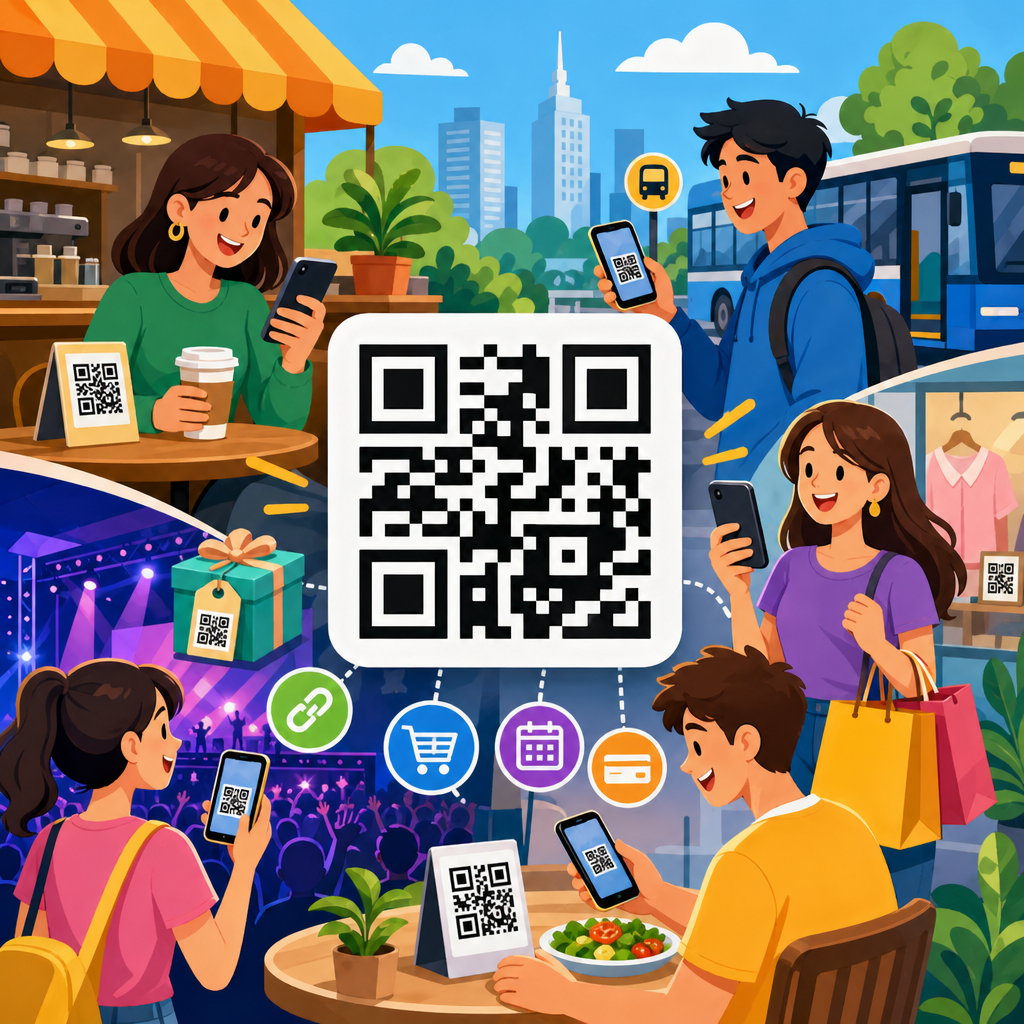
QR codes are popular because they fit many jobs without forcing users to learn a new interface. In restaurants, they open menus, allergen information, ordering systems, and feedback forms. In retail, they connect shelf labels to reviews, stock availability, loyalty enrollment, and product specifications. In payments, they support account-to-account transfers and wallet transactions, especially in regions where QR-based payment rails are standard. In logistics, they identify parcels, bins, components, and maintenance records. In healthcare, they link patients to appointment check-in, medication instructions, and device traceability.
Education and events provide especially clear examples. Universities place QR codes on posters so students can register for talks, download maps, or access reading lists instantly. Conferences use them on badges for lead capture and on session screens for polls, decks, and networking. Museums place codes beside exhibits to deliver multilingual interpretation, accessibility support, and deeper archival content. Real estate agents add codes to yard signs for virtual tours and booking pages. None of these use cases are flashy; they are popular because they remove tiny points of friction that accumulate into meaningful gains.
| Use Case | What the QR Code Does | Why It Is Popular |
|---|---|---|
| Restaurant menus | Opens a live digital menu | Fast updates, lower printing costs, contactless access |
| Product packaging | Links to manuals, videos, authenticity checks | Saves label space and improves post-purchase support |
| Event tickets | Stores scannable entry credentials | Speeds admission and reduces fraud |
| Payments | Launches wallet or bank transfer flow | Works on existing phones without extra hardware |
| Wi-Fi access | Shares network credentials securely | Eliminates manual typing errors |
These examples show the underlying pattern. QR codes are most successful when they bridge a clear intent gap: when a person wants information or access now, but the alternative is typing, searching, waiting, or asking staff. That is why a code on product packaging often performs better than a code in a generic magazine ad. Context drives value. The closer the code is to the moment of need, the more useful and popular it becomes.
The Benefits That Keep QR Codes Growing
The strongest benefit is reduced friction. Typing a long URL, serial number, coupon string, or Wi-Fi password introduces delay and errors. Scanning compresses that process into one action. The second benefit is flexibility. A code can launch almost any digital endpoint, from a landing page to a PDF, app store listing, calendar event, payment request, or support chatbot. The third benefit is persistence across media. The same mechanism works on paper, packaging, glass, fabric, screens, and labels.
Businesses also value updateability and governance. With dynamic QR codes, a printed asset can stay in circulation while the destination changes by season, language, inventory status, or campaign. A restaurant can switch breakfast to lunch automatically. A manufacturer can replace a PDF manual with a newer version. A retailer can reroute a code from a product page to a recall notice if needed. That operational flexibility is a major reason organizations keep expanding QR usage after the first deployment.
From a customer experience perspective, QR codes can improve accessibility when implemented thoughtfully. They can open pages in multiple languages, trigger audio explanations, enlarge text, and route users to screen-reader-friendly content. For field service and industrial environments, codes also support maintenance efficiency. A technician can scan a machine label to pull up parts lists, service history, lockout procedures, and troubleshooting steps at the asset instead of returning to a terminal.
There are limitations, and acknowledging them is part of using QR codes well. They depend on camera access, basic digital literacy, and usually internet connectivity. Poorly placed codes, weak mobile landing pages, and unexplained calls to action reduce results. Security is another concern because malicious codes can redirect users to phishing pages. The practical response is straightforward: use branded domains, preview-enabled scanning, clear destination labels, HTTPS pages, and internal governance for code creation and retirement.
Best Practices for Creating Effective QR Codes
Effective QR codes start with purpose. Every code should answer a simple question: what exact action should the user take after scanning? “Scan to view assembly instructions” outperforms “Scan me” because it sets expectation and improves trust. Match the destination to mobile behavior, keep landing pages lightweight, and remove unnecessary fields. If a code opens a form, prefill what you can. If it opens a menu or manual, jump directly to the relevant section instead of a generic homepage.
Design and testing are operational disciplines, not cosmetic afterthoughts. Use sufficient size, contrast, and quiet zone. Test on multiple phones, under real lighting, at realistic distances, and on the final material, whether matte paper, glossy plastic, corrugate, or digital signage. If you customize colors or add a logo, verify scanning before mass production. Tools such as QR Code Generator, Bitly, Beaconstac, and enterprise product cloud systems can manage dynamic destinations and analytics, but platform choice matters less than workflow discipline.
Finally, think in lifecycle terms. Name codes consistently, document ownership, monitor scan activity, and retire outdated destinations. For printed materials with long shelf life, dynamic codes are usually safer because they allow correction later. For permanent information that should never depend on a vendor platform, static codes remain appropriate. The best implementations treat a QR code as a maintained customer touchpoint, not a one-time graphic export. That mindset is why high-performing programs keep producing value long after launch.
Why QR Codes Will Stay Popular
QR codes are popular today because they fit the way people already use phones: they see something in the physical world, want a digital result immediately, and prefer not to type. The technology is mature, inexpensive, resilient, and supported by default on modern devices. It handles everything from menus and payments to manuals, tickets, traceability, and service workflows. Just as important, it gives organizations a measurable bridge between offline moments and online outcomes.
For anyone learning the fundamentals, the main lesson is simple. A QR code is not valuable because it is trendy; it is valuable when it removes friction at a specific moment of need. That is the central idea behind What Are QR Codes? and it is why this topic belongs at the center of QR Code Basics & Education. If you want better results, start with one practical use case, create a clear mobile destination, test the code in the real environment, and build from there.
Used thoughtfully, QR codes will remain one of the simplest and most effective tools for linking the physical and digital worlds. They work for small businesses, global brands, public institutions, and everyday users because the barrier to entry is low and the utility is immediate. Review your current customer journey, identify one place where typing or searching slows people down, and add a QR code that solves that problem cleanly.
Frequently Asked Questions
Why are QR codes so popular today?
QR codes are popular because they remove friction between the physical and digital worlds. Instead of asking someone to type a long web address, search for a product, download an app, enter payment details, or manually save contact information, a QR code lets them complete that action in seconds with a phone camera. That level of convenience matters in modern life, where speed, simplicity, and low-effort interaction heavily influence what people actually use.
Another major reason is versatility. A single QR code can link to a website, open a restaurant menu, start a payment, connect to Wi-Fi, save a digital business card, verify a ticket, track a package, or provide product information. Businesses, schools, healthcare providers, event organizers, and consumers all benefit because the same basic technology can solve many different communication and transaction problems without specialized hardware.
Widespread smartphone adoption also helped turn QR codes into a mainstream tool. Once most people began carrying phones with cameras and built-in QR scanning support, the barrier to use dropped sharply. Users no longer needed a separate app in many cases, which made scanning feel natural and immediate. In short, QR codes became popular not just because they are clever, but because they are practical, flexible, inexpensive to create, and extremely efficient at connecting offline moments to online actions.
What exactly is a QR code, and how is it different from a traditional barcode?
A QR code, or Quick Response code, is a two-dimensional barcode made up of small square modules arranged in a grid. Those modules encode data that can be read quickly by a camera and software on a smartphone, tablet, or scanner. The information inside a QR code can include a website URL, contact details, payment information, Wi-Fi credentials, app links, tickets, menus, product records, and more.
The biggest difference between a QR code and a traditional barcode is how much information each can store and how it is organized. A standard one-dimensional barcode, such as the kind commonly found on retail packaging, typically stores a relatively short numeric identifier in a series of vertical lines. That identifier usually points to a database entry rather than containing rich information by itself. A QR code, by contrast, stores data in both horizontal and vertical directions, allowing it to hold far more content in a compact space.
QR codes are also generally faster and more flexible in real-world use. They can often be scanned from different angles, resized for many applications, and still remain readable even if part of the code is damaged, thanks to built-in error correction. That makes them useful in places where durability and scan reliability matter, such as shipping labels, posters, restaurant tables, product packaging, event tickets, and mobile payments. In practical terms, a traditional barcode identifies something, while a QR code can often trigger an immediate digital action.
What are the most common uses for QR codes today?
QR codes are used across an unusually wide range of everyday situations because they make digital access immediate. One of the most common uses is linking to websites, landing pages, videos, forms, and app downloads. Businesses place them on posters, product packaging, direct mail, store displays, and advertisements so people can move from seeing a message in the physical world to taking action online without typing anything manually.
They are also heavily used for payments and transactions. In many countries, QR-based payment systems allow customers to scan a code at checkout, confirm the amount, and pay through a banking app or digital wallet. That approach is fast, low-cost, and easy to deploy, especially for small businesses that may not want expensive payment hardware. Similarly, QR codes are common for event ticketing, transportation passes, boarding access, and check-ins because they can be generated quickly and verified electronically.
Beyond commerce, QR codes are useful for practical information sharing. Restaurants use them for digital menus, offices use them for visitor registration, homes and businesses share Wi-Fi login details with them, and professionals use them for digital contact cards. Healthcare providers, manufacturers, logistics companies, and educators also use QR codes to connect users to records, instructions, authentication pages, training content, and resource materials. Their popularity comes from the fact that they are not limited to one industry or one type of task; they are a general-purpose bridge to digital information.
Are QR codes safe to use?
QR codes themselves are not inherently dangerous, but they are only as trustworthy as the destination they lead to. A QR code is simply a machine-readable way of presenting information or triggering an action. If that action opens a legitimate website, payment page, contact card, or secure application, then the experience is generally safe. If it leads to a fraudulent website or deceptive download, however, the risk comes from the content behind the code, not the code format itself.
That is why users should apply the same caution they would use when clicking a link in an email or text message. Before entering sensitive information, it is wise to check the website address, confirm the brand or organization is legitimate, and be cautious of codes placed in suspicious locations or pasted over original materials. For example, a fake QR code sticker placed on a parking meter, restaurant table, or payment terminal could redirect someone to a phishing page. Modern phones often preview the destination before opening it, which gives users a useful opportunity to verify where they are being sent.
For organizations, safety involves both technical setup and user trust. Businesses should use secure destinations, maintain current links, avoid broken redirects, and clearly label what the QR code does. Dynamic QR code platforms, analytics systems, and campaign tools should also be chosen carefully so that privacy and security standards are maintained. In short, QR codes are safe when used responsibly, but like any digital shortcut, they should be scanned with awareness and basic common sense.
Will QR codes continue to grow in popularity in the future?
Yes, QR codes are very likely to remain popular because they solve a durable, ongoing need: fast access to digital actions from physical environments. That need is not going away. If anything, it is expanding as more products, places, services, and experiences become digitally connected. As businesses continue to blend offline marketing, mobile commerce, contactless interactions, and real-time information delivery, QR codes remain one of the simplest and most cost-effective tools available.
Their future strength comes from low complexity and broad compatibility. QR codes are cheap to create, easy to print, and already supported by billions of smartphones. Unlike technologies that require specialized equipment, logins, or advanced user knowledge, QR codes ask very little from the user. That makes them especially valuable for public-facing environments where speed and accessibility matter, such as retail stores, packaging, transportation systems, hospitality, healthcare, education, and live events.
They are also evolving beyond basic link-sharing. Brands now use dynamic QR codes to update destinations without changing the printed code, track campaign performance, personalize customer journeys, and connect physical products to authentication systems, support pages, loyalty programs, or post-purchase experiences. As consumer expectations continue shifting toward instant mobile interaction, QR codes are likely to stay relevant not because they are trendy, but because they are one of the most efficient tools ever created for turning attention into action.