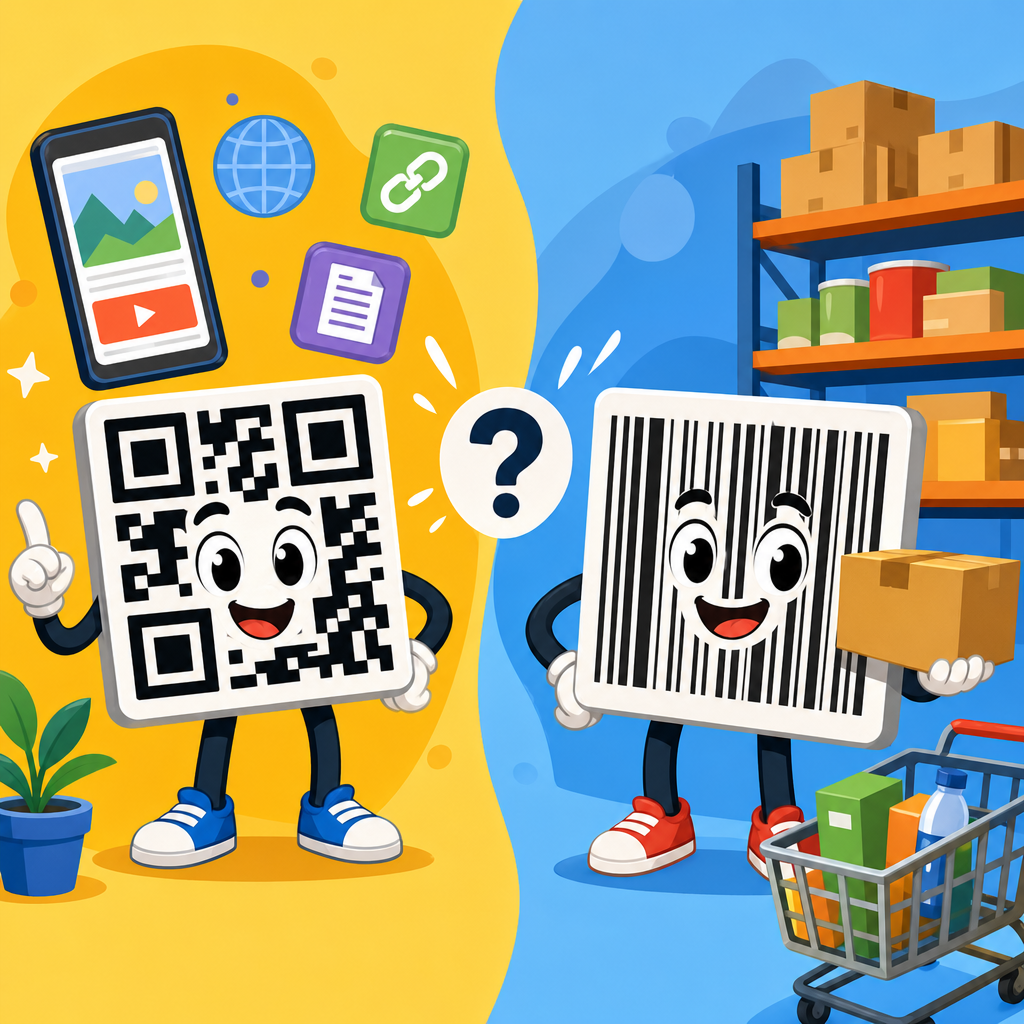
QR codes and barcodes both store machine-readable data, but they differ sharply in structure, capacity, scanning behavior, and practical use. If you work in retail, manufacturing, logistics, marketing, or digital product delivery, understanding that difference is not academic. It affects how quickly items move through checkout, how accurately inventory is tracked, how customers reach online content, and how much information a label can carry before it becomes unusable.
A barcode usually refers to the familiar one-dimensional pattern of vertical lines printed on product packaging. That linear pattern stores data across a single horizontal axis. A QR code, short for Quick Response code, is a two-dimensional matrix made of small black and white squares arranged in a grid. Because it stores data both horizontally and vertically, a QR code can hold far more information in much less space than a traditional barcode. In practice, that means a barcode often points to a simple product identifier, while a QR code can contain a website URL, contact card, Wi-Fi credentials, app link, payment request, serial number, or other structured data.
This distinction matters because businesses no longer use codes only for inventory control. They use them to connect physical objects to digital experiences. I have seen the shift firsthand: warehouse teams still depend on linear barcodes for speed and consistency on cartons and pallets, while marketing, field service, restaurants, event organizers, and healthcare teams rely on QR codes to deliver richer interactions with an ordinary smartphone camera. The rise of mobile-first customer behavior made QR codes mainstream, but barcodes remain essential because they are efficient, standardized, and deeply embedded in supply chains.
To compare them accurately, it helps to define a few terms. A symbology is the specific encoding standard used to represent data visually. UPC and Code 128 are barcode symbologies. QR Code is its own two-dimensional symbology defined by ISO/IEC 18004. Another key term is error correction, which means a code can still be read even when part of it is damaged. QR codes support built-in Reed-Solomon error correction, one reason they perform well on packaging, posters, menus, and outdoor signage. Traditional retail barcodes do not offer the same resilience.
This article serves as a hub for understanding what QR codes are, how they compare with barcodes, when each format is the better choice, and what practical tradeoffs matter before you print either one. If your goal is to choose the right code for labeling, customer engagement, tracking, or payments, the answer starts with how each technology was designed to work.
What are QR codes and how do they work?
A QR code is a two-dimensional matrix code invented in 1994 by Denso Wave, a Toyota subsidiary, to track automotive components more efficiently than linear barcodes allowed. The design solved two problems at once: low data capacity and slow scanning from fixed orientation. A QR code stores information in square modules arranged in a grid, with three large position markers in the corners that help scanners detect orientation instantly. That is why a phone can scan a QR code from different angles so reliably.
The data inside a QR code can be numeric, alphanumeric, byte-based, or encoded as kanji depending on the character set. Capacity varies by version and error correction level, but the key point is simple: a QR code can hold significantly more data than a standard barcode. A Version 40 QR code can encode thousands of characters, though real-world best practice is to keep content compact to preserve scanability. Most business uses put a short URL or identifier in the code and handle the heavier data in a connected system.
Static and dynamic QR codes are also worth separating. A static QR code contains fixed information that cannot be changed after printing. A dynamic QR code typically contains a short redirect URL managed by a platform, allowing the destination to be updated without changing the printed image. In campaigns I have managed, dynamic codes were the safer choice because they supported analytics, destination changes, device-based routing, and expiration controls. Static codes were useful only when the destination was permanent and governance was simple.
QR codes are read by smartphones, dedicated scanners, kiosks, and industrial imagers. Their popularity expanded rapidly because modern mobile operating systems built scanning directly into the camera app. That removed the old friction of downloading a special reader. As a result, QR codes became practical for restaurant menus, event tickets, packaging instructions, contactless payments, product authentication, and service manuals.
What are barcodes and where are they still used?
A barcode is most commonly a one-dimensional code made of parallel bars and spaces that represent numbers or characters. The scanner reads reflected light across the width of the code and converts the pattern into data. Retail barcodes such as UPC-A and EAN identify products at the point of sale. Other linear symbologies, including Code 39 and Code 128, are common in warehousing, shipping labels, asset tracking, and healthcare environments where a compact machine-readable identifier is required.
Barcodes remain dominant in retail because they are fast, inexpensive to print, and fully integrated into global product identification standards managed by GS1. When a cashier scans a UPC on a cereal box, the barcode itself does not hold the price, ingredients, or inventory count. It holds an identifier that the store system matches to a product record in a database. This is efficient because the code stays short and highly readable, even when printed at small sizes on mass-market packaging.
In operations environments, linear barcodes still excel when labels are produced at scale on thermal printers and scanned with laser devices from predictable angles. I have seen distribution centers prefer Code 128 on rack labels because workers can scan quickly at distance with rugged handheld units. A QR code could hold more information, but that extra capacity would provide no advantage if the workflow only needs a location ID or shipment number. Choosing QR by default in that scenario can make labels denser than necessary and reduce scanning comfort at speed.
There are also two-dimensional barcodes beyond QR, such as Data Matrix and PDF417, but for most business comparisons the practical question is still linear barcode versus QR code. Linear codes are optimized for simple identifiers and mature supply-chain systems. QR codes are optimized for higher capacity, flexible scanning, and consumer interaction.
Key differences between QR codes and barcodes
The clearest way to understand the difference between QR codes and barcodes is to compare their design goals. Barcodes were created to identify products efficiently inside controlled scanning environments. QR codes were created to encode more information and scan rapidly from any direction. That design difference drives nearly every operational consequence.
| Feature | Barcode | QR Code |
|---|---|---|
| Data structure | One-dimensional, horizontal | Two-dimensional grid |
| Typical capacity | Low, usually an identifier | High, can store URLs and structured data |
| Scan orientation | Requires more alignment | Omnidirectional scanning |
| Error correction | Limited | Built-in Reed-Solomon error correction |
| Common scanners | Laser and CCD scanners | Camera-based scanners and imagers |
| Best use cases | Retail checkout, inventory, shipping | Marketing, payments, tickets, digital links |
| User interaction | Mostly operational | Operational and consumer-facing |
Capacity is the first practical difference. A UPC barcode typically carries just a product number. A QR code can carry a URL, a vCard, a calendar event, geo coordinates, or plain text. That does not mean more capacity is always better. It means QR codes support more complex interactions when a direct digital action is needed.
Scanning method is the second major difference. Linear barcodes are easiest to scan when the reader crosses the bars at the right angle. QR codes can be recognized from multiple directions because the corner finder patterns anchor the image. This is why a customer can scan a QR code on a poster from a slight tilt with a phone camera, while a retail laser scanner is tuned for a very different workflow.
Durability is another important distinction. Because QR codes include error correction, they can often remain readable even if part of the surface is scratched, wrinkled, or partially obscured. That matters on equipment tags, outdoor signs, and packaging that travels through rough handling. A damaged barcode can become unreadable much faster because the scan line may cross a broken portion of the symbol.
Finally, user expectation differs. People generally do not point their phone at a barcode expecting a web experience. They do expect that from a QR code. The visual language itself now carries meaning. In marketing and product education, that expectation is an advantage.
When should you use a QR code instead of a barcode?
Use a QR code when the code must do more than identify an item. If you need to open a website, launch a payment flow, download a file, register a warranty, verify authenticity, pair a device, or provide multilingual instructions, a QR code is usually the better tool. It turns a printed surface into a digital entry point with minimal friction.
A restaurant menu is a simple example. A linear barcode could identify the menu internally, but it would not work well as a customer-facing bridge to a live menu page. A QR code can send diners directly to the current menu, support updates without reprinting if it is dynamic, and route by device language or location. The same logic applies to packaging inserts, museum exhibits, pharmaceutical leaflets, and event signage.
Use QR codes when scan conditions are unpredictable. Smartphone users scan from odd angles, in mixed lighting, and with varying camera quality. QR codes are designed for that environment. They are also better when some damage is likely, because error correction provides resilience. In field operations, I have used QR codes on service stickers that linked technicians to maintenance history. Even when labels were scuffed, scan rates stayed acceptable.
Choose a barcode when the process depends on established retail or warehouse standards, especially where GS1 compliance, legacy scanner compatibility, and ultra-fast repetitive scanning matter most. In many businesses, the right answer is not either-or. It is both: a barcode for operational identification and a QR code for richer digital interaction on the same package or asset label.
Best practices for creating effective QR codes
A good QR code is not just a generated image. It is a scannable, governed, measurable access point. Start with the shortest practical destination, ideally a managed short URL for dynamic control. Avoid encoding long raw links when a redirect will do the job better. Keep strong contrast, usually black on white, and preserve the quiet zone, the empty margin around the code that scanners need for detection.
Size matters. For print, a common rule is to increase code size as scan distance increases. A small package label may scan well at around 2 centimeters square in controlled conditions, but a poster viewed from several feet away needs a much larger symbol. Test on both iPhone and Android devices, under realistic lighting, before approving production. Too many teams only test on desktop previews or one flagship phone and discover problems after launch.
Do not over-customize. Branded QR codes with logos and colors can work, but every visual change consumes error-correction headroom. I have seen attractive designs fail because the logo covered too much of the central area or the contrast dropped below reliable levels. Use customization sparingly and test aggressively. Also label the action clearly. A short callout such as “Scan to view setup guide” improves response because users know what they will get.
Security and maintenance are part of best practice as well. Broken links, expired certificates, and unmanaged redirects ruin trust. If a QR code points to a web page, monitor destination uptime and keep the content mobile friendly. If it handles payments or authentication, use secure domains, clear branding, and anti-phishing guidance. The code is only the doorway; the destination experience determines whether it succeeds.
Common misconceptions about QR codes and barcodes
One common misconception is that QR codes are replacing barcodes everywhere. They are not. Barcodes still power enormous portions of retail and logistics because they are simple, cheap, and embedded in existing infrastructure. Another misconception is that QR codes always hold a lot of information directly. In practice, many high-performing QR codes contain only a short redirect URL, because that makes them easier to manage and scan.
Some people assume any phone can scan any code equally well. Real performance depends on camera quality, lighting, print resolution, surface glare, code size, and symbology support. Another mistaken belief is that damaged QR codes always scan because of error correction. They are more tolerant than barcodes, not indestructible. If contrast is poor or too much of the symbol is obscured, scans will fail.
There is also confusion around safety. A QR code itself is not inherently dangerous, but it can point to malicious destinations just as a link in an email can. The right response is governance, not fear: use trusted domains, preview URLs where possible, and educate users to avoid scanning random codes placed over legitimate signage.
For most organizations, the practical takeaway is straightforward. Use barcodes for standardized identification in operational systems. Use QR codes when you need higher capacity, flexible scanning, or a direct path from a physical object to digital content. If you are building a modern “QR Code Basics & Education” resource center, start with those fundamentals, then branch into topics like static versus dynamic QR codes, QR code sizes, QR code error correction, QR code security, and QR code tracking. Review your current labels, packaging, and customer touchpoints, then choose the code that matches the job.
Frequently Asked Questions
What is the main difference between a QR code and a barcode?
The main difference is how the data is arranged and how much information each format can hold. A traditional barcode stores data in a one-dimensional pattern of vertical lines and spaces. Because the information runs in a single direction, it usually carries a short identifier such as a product number or SKU. A QR code, by contrast, is a two-dimensional code made up of small squares arranged both horizontally and vertically. That layout allows it to store far more data in a much smaller area.
In practical terms, a barcode is typically used as a pointer to information stored elsewhere in a database. When scanned at checkout or in a warehouse, the barcode tells the system which product it represents, and the software pulls the rest of the details from a connected inventory or pricing system. A QR code can also point to external information, but it can do much more on its own, including storing website URLs, contact information, serial numbers, authentication data, payment details, and other structured content.
That is why barcodes remain dominant in retail and logistics workflows where speed, simplicity, and standardization matter most, while QR codes are common in customer engagement, digital access, mobile payments, and situations where a label needs to carry more complex information directly.
Do QR codes store more information than barcodes?
Yes, QR codes store significantly more information than standard barcodes. A typical one-dimensional barcode is designed to hold a relatively small string of characters, often just enough to identify a product or shipment. That limitation is not a flaw; it is actually part of what makes barcodes fast, reliable, and easy to print at scale. For many business processes, a short identifier is all that is needed.
QR codes were developed to overcome those storage limits. Because they use a matrix of black and white modules instead of a single line of encoded data, they can hold hundreds or even thousands of characters depending on the type of data and the amount of error correction used. This makes them much better suited for applications where the code itself needs to contain meaningful content, such as a web address, setup instructions, ticketing credentials, or batch-specific product data.
Still, higher capacity does not automatically make QR codes the better choice. If your system only needs to identify an item quickly at a point of sale or during warehouse movement, a barcode is often more efficient and cost-effective. If you need a code to deliver digital experiences, support traceability, or carry more complex data without relying entirely on a backend lookup, a QR code is usually the stronger option.
Are QR codes easier to scan than barcodes?
In many situations, yes. QR codes are often easier and more flexible to scan because they can be read from multiple angles and do not require the scanner to align perfectly with a single horizontal line of data. Since a QR code stores information in two dimensions, imaging devices such as smartphone cameras and modern area scanners can capture the full code quickly, even when the code is rotated or placed in an awkward position.
Barcodes can also be scanned very quickly, especially in environments designed around them, such as supermarket checkout lanes and industrial conveyor systems. In fact, in those settings, one-dimensional barcodes are often extremely efficient because the scanners, software, and label standards have been optimized for decades. However, they generally depend more on orientation and clean line visibility. If the code is wrinkled, partially obscured, poorly printed, or scanned at the wrong angle, read performance can drop.
QR codes also have built-in error correction, which allows them to remain readable even when part of the symbol is damaged or obscured. That feature can be a major advantage on packaging, posters, outdoor signage, and product labels exposed to wear. So while barcodes are still excellent for high-speed operational scanning, QR codes usually offer better flexibility and resilience in real-world consumer and mobile use.
When should a business use a barcode instead of a QR code?
A business should usually choose a barcode when the goal is fast, standardized identification within an internal or commercial scanning system. Retail checkout, warehouse picking, pallet tracking, shipping labels, and inventory management are classic examples. In these environments, the code typically only needs to represent a product ID, order number, or location reference. The full record lives in the business system, so there is no need to place large amounts of data on the label itself.
Barcodes also make sense when compatibility is a priority. Many legacy scanners, point-of-sale systems, and supplier workflows are built around established barcode standards such as UPC, EAN, or Code 128. Using a barcode can simplify compliance, reduce implementation costs, and avoid friction across supply chains. They are also visually simple and often take less effort to integrate into existing packaging and labeling processes.
Another important reason to use barcodes is operational efficiency. In controlled environments where labels are consistently printed and scanners are purpose-built, one-dimensional barcodes can be extremely fast and dependable. If the use case does not require customer interaction, mobile scanning, or large embedded data payloads, a traditional barcode is often the most practical and economical choice.
When is a QR code the better option?
A QR code is the better option when you need to connect physical items to digital content or embed more information directly into the code. That includes product packaging that links to instructions, menus that open on a smartphone, event tickets, digital payments, product authentication, app downloads, warranty registration, and marketing campaigns. In all of these cases, the ability to store richer data and support easy smartphone scanning makes QR codes especially valuable.
QR codes are also useful when flexibility matters. A single code can lead a customer to a landing page, video, review form, support portal, or personalized experience. In manufacturing and logistics, QR codes can support more detailed traceability by carrying lot numbers, serial numbers, timestamps, or process data in a compact format. They are also effective in environments where part of the label may become dirty or damaged, because their error correction improves readability under imperfect conditions.
For many organizations, the best answer is not choosing one over the other universally, but using each where it fits best. A barcode may handle internal stock control and retail scanning, while a QR code on the same package supports customer engagement, setup guidance, or after-sales service. Understanding the difference allows businesses to design labeling systems that are faster, more informative, and more useful across the full product journey.