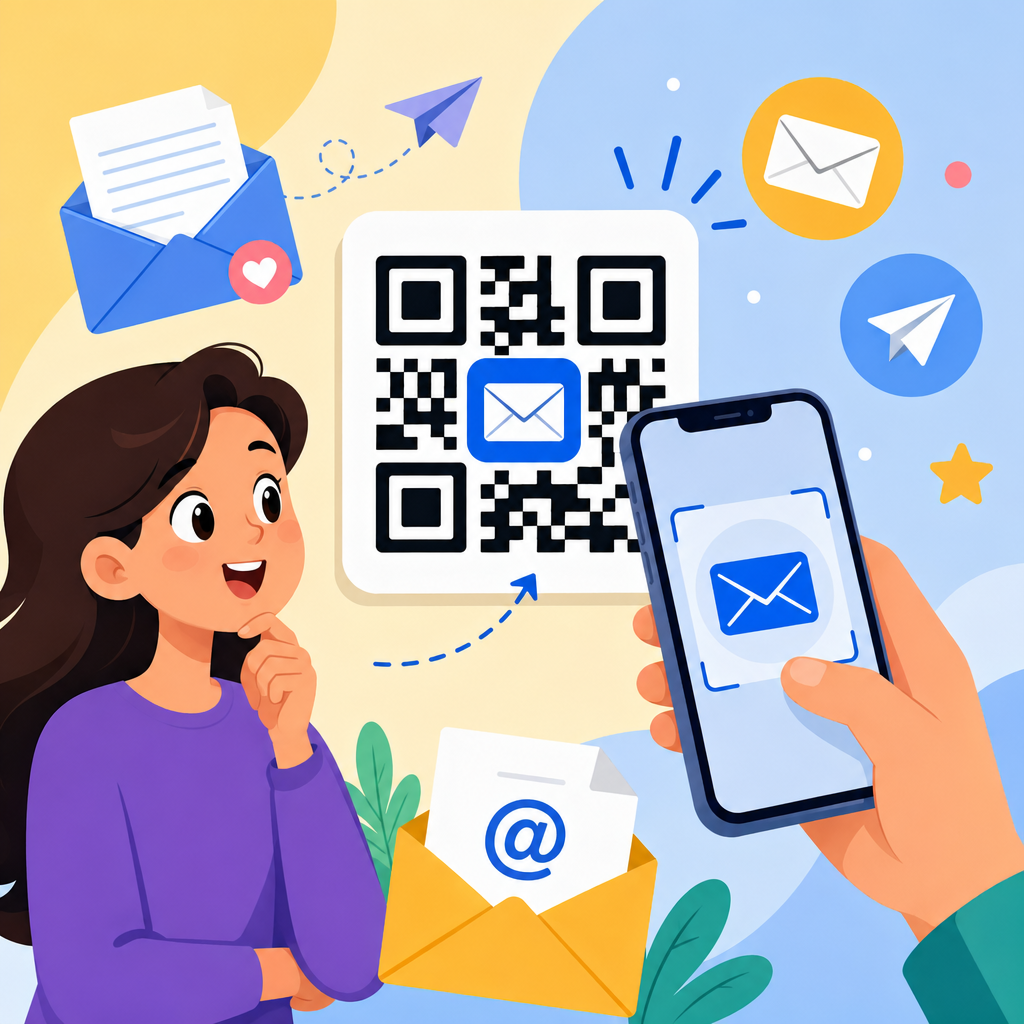
An email QR code is a scannable code that opens a user’s default email app with the recipient address, subject line, and sometimes body text already filled in. In practical terms, it turns the act of contacting a person or business into one camera scan instead of a series of manual steps. That simple change matters more than it sounds. I have used email QR codes in product packaging, conference booths, printed invoices, restaurant table cards, and service vans, and the pattern is consistent: when people do not have to type, response rates improve and errors drop.
Within QR code basics and education, email QR codes sit inside the wider family of QR code types. A QR code type is simply the kind of action or data the code triggers after a scan. Some codes open a website, some save a contact card, some connect to Wi-Fi, some launch a payment flow, and some, like email QR codes, start a message. Understanding where email QR codes fit helps businesses choose the right format for each customer interaction rather than defaulting to a generic web link.
The core technology is straightforward. Most email QR codes encode a mail instruction, often using the mailto format, which can include a destination address, a preset subject, and encoded body content. When scanned, the phone interprets that instruction and passes it to an email client such as Apple Mail, Gmail, or Outlook. Because the action is familiar and low friction, email QR codes are especially useful when the goal is customer support, lead capture, warranty registration, quote requests, feedback collection, or event follow-up.
This topic matters because QR campaigns fail when the code type does not match user intent. If someone wants to ask a question, sending them to a homepage creates extra clicks and often loses the conversion. An email QR code can be the better choice because it starts the exact action the user wanted in the first place. As a hub for the broader subject of types of QR codes, this guide explains what an email QR code is, how it works, when to use it, how it compares with other QR code formats, and what implementation details determine whether it performs well in the real world.
How an Email QR Code Works
An email QR code usually contains a mail instruction in a format a device can understand immediately. The basic structure is simple: recipient address, optional subject, and optional message body. For example, a service company might encode support@company.com with the subject “Service Request” and a body prompt like “Please describe the issue and include your order number.” That prompt is not decorative. In my campaigns, prefilled body text improves message quality because users know exactly what information to provide.
When a smartphone camera recognizes the code, the operating system offers to open the email app. That creates an important distinction from a website QR code. A website QR code sends the user into a browser; an email QR code sends the user into a communication workflow. If the user has no email app configured, the experience can break, so testing across iPhone and Android devices is essential. On managed enterprise phones, corporate mail clients may behave differently than consumer devices, which is another reason to validate the scan path before printing thousands of assets.
Email QR codes can be static or dynamic in their campaign context. The mail instruction itself is generally fixed, but teams often distribute different codes by department, location, or product line to segment incoming inquiries. A retailer might print one code for returns, another for bulk orders, and another for supplier contact. That segmentation gives clearer routing and cleaner reporting. If the business needs editable destinations or detailed analytics after printing, a dynamic redirect to a landing page or form may be a better operational choice than a direct email action.
Where Email QR Codes Fit Among QR Code Types
To understand the value of an email QR code, compare it with the main types of QR codes used in business and education. URL QR codes open a webpage and are the most common option for menus, promotions, and downloads. vCard QR codes save contact details directly to the phone. SMS QR codes open a text message draft. Phone QR codes initiate a call. Wi-Fi QR codes join a network. App store QR codes route to a download page. Payment QR codes start a transaction through region-specific payment systems. File QR codes deliver PDFs, images, or documents. Location QR codes open a map pin. Event QR codes add calendar details. Each type removes friction from a different task.
Email QR codes are strongest when the desired outcome is a thoughtful, asynchronous message. They are weaker when speed is critical, such as roadside assistance, where a phone QR code is better, or when structured data collection matters, where a web form QR code can enforce required fields. I often frame the decision this way: if the user needs to explain, attach, or document something, email is a strong fit. If the user only needs to tap once for information, a URL code is usually better.
| QR code type | Primary action | Best use case | Main limitation |
|---|---|---|---|
| Opens a drafted email | Support, inquiries, feedback | Depends on configured email app | |
| URL | Opens a webpage | Menus, campaigns, product pages | Can add extra steps before conversion |
| SMS | Opens a drafted text | Short mobile interactions | Limited message length and context |
| Phone | Starts a call | Urgent contact | Not ideal for detailed requests |
| vCard | Saves contact information | Networking, sales reps | Does not start a conversation by itself |
| Wi-Fi | Joins a wireless network | Hotels, offices, events | Security and credential update concerns |
Common Use Cases and Real-World Examples
The most effective email QR codes appear where the user already expects to ask a question or send details. On product packaging, a code labeled “Need help with setup? Email our support team” can outperform a generic help-site link because the customer reaches out at the exact moment of friction. I have seen this work particularly well for electronics, home fitness equipment, and specialty food subscriptions, where setup questions are specific and often require photos or order information.
In events, email QR codes are useful for sponsor inquiries, speaking requests, and post-conference follow-up. A booth team can place a code on signage that drafts an email to partnerships@brand.com with a subject line such as “Event Follow-Up” and body prompts for company name, project scope, and timeline. That structure improves lead quality without forcing attendees into a long form while standing in a crowded hall.
Field service businesses also benefit. On an invoice or van decal, an email QR code can open a maintenance request addressed to a regional service desk. The prefilled body can ask for asset ID, site address, and preferred callback window. For schools and local government, email QR codes can direct parents or residents to the correct department while reducing mistyped addresses. In every case, clarity on the label matters as much as the code itself. People scan when they know exactly what will happen next.
Advantages, Limits, and When Another Type Is Better
The biggest advantage of an email QR code is reduced friction. Users do not need to remember an address, switch between apps, or type a subject line. That improves completion rates and reduces submission errors. A second advantage is context. Prefilled copy can guide the user to include order numbers, product names, or dates, which shortens resolution time for internal teams. A third advantage is compatibility with existing workflows. Many businesses already rely on shared inboxes, ticket routing rules, and CRM integrations tied to email, so the code fits current operations without new software.
There are limits. Email is not universally configured on every device, especially among younger users who live in messaging apps. Some native camera apps detect mail instructions smoothly; others hand off awkwardly depending on the installed client. Tracking is also less precise than with a web-based dynamic QR code because the email action happens inside the user’s app. You may know how many scans occurred only if you use a redirect layer, and even then you may not know how many drafted emails were sent.
Another drawback is inconsistent formatting support. Long body text can render differently across clients, and special characters must be encoded correctly. If your process requires mandatory fields, file uploads, consent checkboxes, or analytics tied to campaign variants, a landing page or form QR code is usually the better option. If urgency matters, use a phone QR code. If the goal is simply to share information, use a URL or PDF QR code. Matching the QR code type to the customer’s next action is the governing principle.
Best Practices for Creating an Effective Email QR Code
Start with one outcome. Do not make a single code serve support, sales, recruiting, and complaints at once. Use a dedicated mailbox or alias for each purpose, and write the subject line so your team can route quickly. For example, “Warranty Claim,” “Wholesale Inquiry,” or “Press Request” is better than “Hello.” Keep the prefilled body short but useful. Ask for two to four pieces of information, not ten. The code should make sending easier, not turn the email draft into a form no one wants to complete.
Label the code with a plain-language call to action. “Scan to email support” works better than “Scan me.” In print, maintain adequate quiet zone, strong contrast, and a size that matches scanning distance. A common baseline is at least 2 x 2 centimeters for close-range scans, though larger is safer on packaging, posters, and outdoor materials. Error correction helps, but do not rely on it to rescue a poor design. Logos, inverse colors, glossy surfaces, and curved placements can all reduce scan reliability.
Test on current iPhone and Android devices, using both native camera apps and common mail clients. Validate special characters, spaces, line breaks, and subject formatting. If analytics matter, use campaign-specific codes by channel or location and pair them with mailbox tags or aliases. Review inbound volume, response time, and resolution quality, not just scan counts. In my experience, the best-performing email QR code programs are operationally disciplined: the code is clear, the mailbox is monitored, and replies arrive fast enough to justify the scan.
Security, Privacy, and Measurement Considerations
Email QR codes are low risk compared with executable downloads, but they still require governance. Users should know who they are emailing and why. Hidden destinations, vague labels, or deceptive branding undermine trust. Businesses should use monitored addresses on verified domains and publish clear contact and privacy information elsewhere on the asset or nearby page. If the email may include personal data, route it to the right team and apply retention rules consistent with your organization’s policies and any applicable regulations.
Measurement requires realism. A direct mail instruction does not provide the same analytics depth as a dynamic URL QR code managed through a platform such as Bitly, QR Code Generator PRO, Beaconstac, Flowcode, or Scanova. If campaign insight is essential, consider a two-step flow: scan to a lightweight contact page with tracking, then offer email as the preferred channel. That adds friction, so it is a strategic tradeoff, not a universal improvement.
The takeaway is simple. Email QR codes are a practical, high-intent member of the broader types of QR codes family. They work best when the user needs to contact you with context, when your team can respond through established inbox workflows, and when the scan experience is tested carefully. Choose email when conversation is the goal, choose another QR code type when speed, structure, or analytics are more important. If you are building a QR code strategy under QR Code Basics and Education, audit your customer touchpoints and assign the code type that removes the most friction from the next action.
Frequently Asked Questions
What is an email QR code, and how does it work?
An email QR code is a scannable code that launches a person’s default email application with key fields already prepared, usually the recipient address, subject line, and sometimes a short message in the body. Instead of asking someone to manually type an email address, remember a subject, and compose a message from scratch, the QR code reduces the process to a quick camera scan and tap. In most cases, the code contains a mail action format such as a mailto link, which compatible smartphones recognize and use to open the email app automatically.
That convenience is what makes email QR codes so useful in real-world settings. On packaging, invoices, table tents, event signage, business cards, and service vehicles, they create a fast bridge between offline materials and digital communication. When someone scans the code, they are not sent to a webpage first unless the code was designed that way. Instead, they are taken directly into the act of contacting the business or person. Fewer steps usually means less friction, and less friction often leads to more inquiries, support requests, feedback, and sales conversations.
What information can you include in an email QR code?
The most common elements in an email QR code are the destination email address and a prewritten subject line. Many email QR codes also include body text, which can be especially helpful when you want to guide the user toward a specific type of message. For example, a support-related QR code might open an email draft addressed to help@yourcompany.com with a subject such as “Warranty Request” and body text that prompts the customer to add their order number and issue details. A sales inquiry code might open with a subject like “Request for Quote” and a few lines that make it easy for the customer to describe what they need.
This prefilled structure improves both user experience and internal organization. It helps the sender know what to write, and it helps the recipient categorize incoming emails more efficiently. That said, it is best to keep prefilled content practical and concise. If the subject is too long or the body is overloaded with text, the draft can feel cluttered on mobile devices. A smart setup gives users a helpful starting point without making the message feel rigid or over-scripted.
When should you use an email QR code instead of a website or contact form QR code?
An email QR code is best when your goal is to start a direct, one-to-one conversation quickly. If someone simply needs a frictionless way to ask a question, request service, send a document, or follow up after seeing printed material, email is often the fastest route. This makes email QR codes especially effective for customer support, B2B outreach, invoice questions, event follow-up, product registration assistance, and service-based businesses where personal communication matters. In these situations, opening the email app directly is often more efficient than sending people to a landing page and asking them to complete additional steps.
A website or contact form QR code may be better if you need structured data collection, analytics tied to page behavior, multiple conversion options, or a more controlled branded experience. Forms are useful when you want mandatory fields, lead qualification, or routing rules. But if the main objective is to make contact feel instant and accessible, email QR codes often outperform more complex paths because they remove barriers. In practice, the best choice depends on intent: use email QR codes for direct communication, and use webpage or form QR codes when you need a broader funnel or more data capture.
Are email QR codes effective for marketing, customer service, and offline materials?
Yes, they can be extremely effective because they connect physical touchpoints to immediate action. In marketing, an email QR code can turn a brochure, booth sign, direct mail piece, or product insert into a low-friction response channel. Instead of hoping someone remembers your address later, you give them a one-scan way to start the conversation while interest is still high. In customer service, the value is even more obvious. A code printed on packaging, receipts, manuals, invoices, or equipment labels can help customers reach the right department quickly, often with a subject line that tells your team exactly what the inquiry is about.
The reason they work so well on offline materials is simple: they reduce drop-off caused by manual effort. Every extra step, typing an address, switching apps, deciding what to write, creates opportunities for hesitation. Email QR codes remove much of that hesitation. They are particularly useful in places where people are standing, walking, waiting, or dealing with a product in real time. If someone is at a conference booth, seated at a restaurant table, reviewing an invoice, or looking at a service van in a parking lot, a scan-based contact method feels natural. When implemented clearly and paired with a compelling reason to act, email QR codes can meaningfully increase response rates.
What are the best practices for creating and using an email QR code?
Start with a clear purpose. Decide whether the code is meant for support, sales, feedback, bookings, or general inquiries, then tailor the recipient address and subject line accordingly. Use a specific email address whenever possible rather than a generic inbox if internal routing matters. Keep the subject short and descriptive, and use body text only when it genuinely helps the user get started. A short prompt such as “Please include your order number and a brief description of the issue” is usually more effective than a long prewritten paragraph. The easier the draft is to review and send, the better the user experience will be.
Design and placement also matter. Make sure the QR code is large enough to scan easily, printed with strong contrast, and placed where people naturally look when they are ready to take action. Add a short call to action near the code, such as “Scan to email support” or “Scan to request a quote,” so users know exactly what will happen. Test the code across different devices and email apps to confirm that it opens properly and populates the fields as intended. If you are using the code in multiple locations, consider creating distinct versions with different subject lines so you can better understand where inquiries are coming from. The best email QR codes are simple, intentional, and built around reducing effort at the exact moment someone is most likely to reach out.