A secure QR code, commonly called an SQRC, is a Quick Response code that looks similar to a standard QR code but contains access-controlled data that only authorized scanners can read. In practical terms, it is a two-layer code: one layer is public and can be scanned by ordinary devices, while the protected layer requires a specific reader, cryptographic key, or application permission. That design makes SQRC useful when organizations want the speed and convenience of QR codes without exposing sensitive information to every camera app.
Within QR code basics and education, SQRC sits inside the broader category of QR code types. Understanding where it fits matters because many teams assume every QR code works the same way. They do not. Static QR codes store fixed information. Dynamic QR codes point to a short URL that can be edited, tracked, and managed after printing. Specialized variants include Micro QR, iQR Code, Frame QR, model-based industrial codes, and secure formats such as SQRC. Each type exists because different operating environments demand different capacities, error correction levels, scan distances, security controls, or branding options.
I have worked with QR code deployments in retail packaging, event operations, and internal asset management, and the same misunderstanding appears repeatedly: people confuse privacy, authentication, and anti-counterfeit functions. A normal QR code can link to a secure website, but the symbol itself is not secure. By contrast, an SQRC is designed so part of the encoded content is intentionally restricted. That distinction is important for product traceability, ticketing, membership verification, visitor management, and factory workflows where exposing raw data creates operational or compliance risk.
This topic matters because QR codes now sit at the intersection of physical and digital systems. They open doors, start payments, validate identities, register warranties, route parcels, and trigger maintenance records. When the wrong type of QR code is chosen, companies run into predictable problems: copied tickets, spoofed labels, broken links, no analytics, or incompatible scanners. A clear overview of QR code types, with SQRC explained in context, helps teams choose the right symbol for the job instead of forcing one format into every use case.
What a Secure QR Code Is and How It Works
An SQRC is a QR-based symbology originally associated with DENSO WAVE, the company that developed the QR Code. Its defining feature is the ability to embed both open and non-public data in the same symbol. To a standard smartphone camera, the public portion may resolve normally or reveal only limited information. To an approved scanner configured with the correct decoding method, the hidden portion becomes readable. The point is not visual secrecy alone; it is controlled data access at the decoding stage.
That structure makes SQRC fundamentally different from simply placing a password-protected web page behind a standard QR code. With a conventional code, the encoded string itself is usually fully readable by any decoder, even if the destination later asks for login credentials. With SQRC, protected information can remain inaccessible unless the scanner has the proper authorization. In environments where encoded serials, batch records, location IDs, or entitlement data should not be openly harvested, that difference is significant.
In real deployments, SQRC often works alongside backend verification. For example, a manufacturer can print one code on a component label. Warehouse workers using company handhelds read both public and restricted fields for receiving and traceability. Contractors or end users scanning the same symbol with a standard phone see only public support information. That reduces label clutter and avoids printing separate public and internal codes on the same item.
How SQRC Fits Among the Main Types of QR Codes
To understand who uses SQRC, it helps to compare it with the main QR code types used today. Static QR codes are fixed after creation; if the destination changes, the code must be reprinted. Dynamic QR codes use a redirect, allowing edits, analytics, device targeting, expiration rules, and campaign control. Micro QR is designed for very small spaces and uses fewer modules. iQR Code can store more data in a smaller footprint and can be printed in rectangular forms. Frame QR reserves a central canvas area for logos or messaging. Industrial direct part marking may use QR variants optimized for metal, plastic, or etched surfaces. SQRC adds access control.
The right choice depends on purpose. If a restaurant needs a menu link it can update, dynamic is usually the practical option. If a machine part has almost no label space, Micro QR or a direct-marking approach may be considered. If a ticket needs visible branding and customer-facing scanning, Frame QR may help. If a defense supplier or pharmaceutical plant needs one printed symbol that separates public instructions from restricted operational data, SQRC becomes more relevant than conventional marketing-oriented formats.
| QR code type | Primary strength | Common use | Main limitation |
|---|---|---|---|
| Static QR | Simple and permanent | Wi-Fi, contact cards, fixed URLs | Cannot be edited after printing |
| Dynamic QR | Editable destination and analytics | Marketing, packaging, menus, campaigns | Depends on a managed redirect service |
| Micro QR | Works in tiny print areas | Small parts and compact labels | Lower capacity than standard QR |
| Frame QR | Supports branding inside the code area | Consumer promotions and packaging | Design changes can affect scan reliability |
| SQRC | Restricts access to protected data | Authentication, internal tracking, secure operations | Requires compatible authorized readers |
Who Uses Secure QR Codes
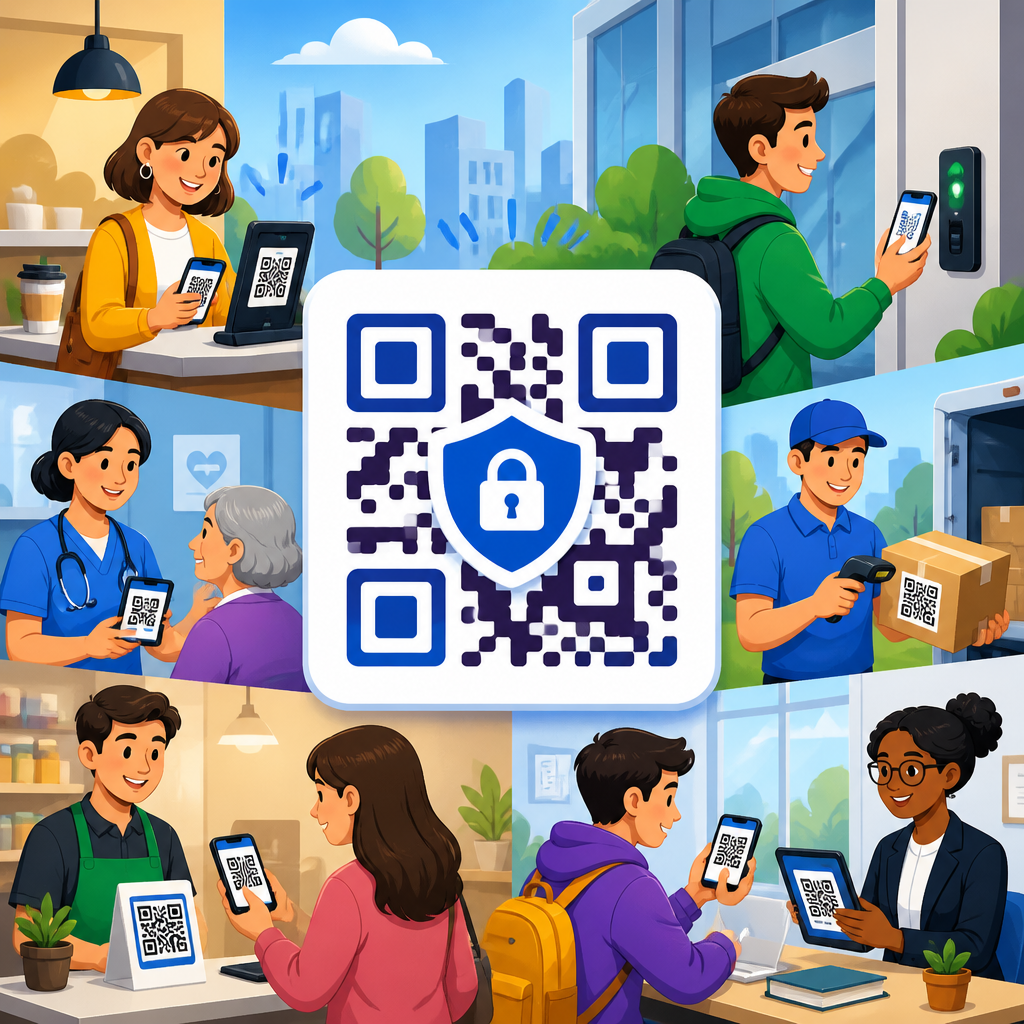
SQRC is most useful in sectors where a printed code must do more than launch a webpage. Manufacturing is one of the clearest examples. Plants often need labels that support line-side identification, lot control, service instructions, and anti-mix checks. A public layer can show a model page or maintenance manual. The secure layer can hold plant-specific routing, supplier credentials, or internal serial relationships that should not be visible to anyone with a phone.
Event operators and venue security teams also benefit when they need stronger ticket control. A standard QR code can identify a ticket, but copied screenshots remain a problem unless the system validates every scan in real time. An SQRC can add protected data for gate devices, making duplication harder and reducing the usefulness of exposed visible payloads. It is not a complete fraud-proofing solution by itself, but it adds a meaningful control when combined with rotation rules, scan logs, and server-side validation.
Membership organizations, campuses, hospitals, and corporate facilities use secure codes for access and identification workflows. In healthcare, for example, it may be appropriate to expose patient-facing educational content publicly while keeping internal routing or inventory metadata restricted to approved devices. In logistics, parcel operators can use one code for consumer tracking and a protected layer for internal handling instructions. In luxury goods and regulated products, brands use secure codes as one element in anti-counterfeit programs, especially when paired with serialization and database lookups.
Security Benefits, Tradeoffs, and Common Misconceptions
The main benefit of SQRC is selective disclosure. One symbol can serve multiple audiences without revealing everything to everyone. That helps reduce data leakage, simplify labels, and support role-based workflows. In my experience, operations teams value this because it lowers the temptation to overprint labels with separate public, internal, and compliance identifiers. It also improves usability for field staff who need one reliable scan target.
However, SQRC should not be treated as magical protection. It is one layer in a larger security design. If a secure scanner is compromised, if backend authorization is weak, or if printed codes are physically cloned, risk remains. Strong implementations pair the symbol with signed records, rotating credentials where possible, access logs, and reconciliation rules. For consumer authentication, many brands also check scan frequency, geography anomalies, and first-scan timestamps to identify suspicious behavior.
Another misconception is that any “encrypted QR code” is equivalent to SQRC. Many software vendors describe password-protected links or encoded text as secure, but that is not the same thing as a standardized access-controlled symbol format. Security can exist at several layers: the symbol, the payload, the transport connection, the web application, and the business process. A code linking to an HTTPS page protects data in transit, but it does not stop anyone from reading the visible URL in the code itself. A dynamic code with tokenized redirects can improve control, but it solves a different problem than restricted decoding.
Compatibility is the biggest operational tradeoff. Standard camera apps are built for ordinary QR decoding, not specialized secure payload access. That means SQRC usually requires approved applications or hardware scanners. For closed environments such as factories, warehouses, and enterprise facilities, that requirement is often acceptable. For broad consumer campaigns, it may create too much friction unless the public layer alone delivers enough value.
How to Choose the Right QR Code Type for a Project
Start with the question, “Who needs to scan this code, and what should each person be allowed to see?” If the answer is everyone sees the same thing and the destination may change, dynamic QR is usually the default. If the content will never change and long-term independence from a platform matters, static may be better. If physical space is constrained, evaluate Micro QR or direct part marking approaches. If brand presentation is central, consider Frame QR carefully and test scan performance on real devices. If one symbol must separate public and restricted information, shortlist SQRC.
Next, define operating constraints. Print size, contrast, substrate, curvature, scan distance, and expected damage all affect performance. ISO/IEC 18004 governs QR Code specifications, and quality grading is commonly assessed under ISO/IEC 15415 for two-dimensional printed symbols. In production settings, verifier tools from companies such as Cognex, Keyence, Zebra, and Omron are used to test readability before rollout. Those checks matter more than most teams expect. A secure format still fails if the code is too small, poorly printed, or placed on reflective material.
Then evaluate governance. Who controls edits, redirects, encryption keys, scanner permissions, and incident response? For secure use cases, choose a provider or internal architecture that supports audit trails, role-based access, and lifecycle management. Plan for revocation and reissuance. Finally, test with actual users in the real environment. The best QR code type on paper is the one that scans quickly, integrates cleanly, and supports the intended workflow without exposing unnecessary data.
Best Practices for Building a QR Code Education Hub
Because this page serves as a hub for types of QR codes, it should connect readers logically to deeper topics. The most useful supporting articles usually include static versus dynamic QR codes, Micro QR codes, branded and Frame QR codes, QR code error correction, QR code security risks, anti-counterfeit labeling, direct part marking, and QR code testing standards. That structure helps beginners move from broad understanding to implementation details without confusion.
Keep definitions precise. Explain that “QR code” is both a general category in everyday speech and a specific standardized symbology in technical contexts. Distinguish symbol type from campaign setup. A dynamic landing page strategy is not itself a new symbol type. Likewise, a secure web form accessed through a QR code is not automatically a secure QR format. These distinctions prevent the vague language that often leads to poor purchasing and deployment decisions.
The strongest educational content uses plain language but includes standards, tools, and examples. Readers should leave knowing not only what an SQRC is, but also when not to use one. If the audience is broad consumers, compatibility constraints may outweigh security benefits. If the environment is controlled and the risk of open data exposure is high, SQRC is often the correct answer.
A secure QR code is best understood as a specialized QR code type built for controlled access to encoded information. It differs from standard static and dynamic QR codes because it restricts part of the payload to authorized readers, making it useful for manufacturing, ticketing, logistics, healthcare, facilities, and anti-counterfeit programs. That is the central takeaway for anyone studying QR code basics: the symbol on the page may look familiar, but the underlying behavior can be very different.
As a hub topic, types of QR codes should always be evaluated through purpose, audience, and operating conditions. Static codes are simple and durable. Dynamic codes add flexibility and measurement. Micro and branded formats solve space or presentation needs. SQRC addresses controlled visibility. None is universally best. The right choice depends on who scans, what data is exposed, what systems must connect, and how much governance the organization can support over time.
If you are planning a deployment, map your use case before generating a single code. List the scanners, the data fields, the print surfaces, the validation rules, and the security risks. Then compare the available QR code types against those requirements and test them in the field. That disciplined approach will help you choose whether a standard QR code is sufficient or whether an SQRC is the smarter fit for your operation.
Frequently Asked Questions
What is a Secure QR Code (SQRC), and how is it different from a regular QR code?
A Secure QR Code, or SQRC, is a specialized type of QR code designed to hold both publicly readable information and protected data that only authorized systems can access. At a glance, it often looks like a standard QR code, but its structure is more advanced. A conventional QR code typically stores data that any compatible scanner app can read immediately, such as a URL, serial number, contact card, or product identifier. An SQRC, by contrast, is built with access control in mind.
The key difference is that an SQRC can operate as a two-layer code. One layer may contain general information that is visible to ordinary smartphones or scanners, while another layer is encrypted or otherwise protected so that only approved readers, software, or devices with the proper cryptographic credentials can decode it. This means organizations can distribute information quickly and conveniently through a familiar QR-code format without making all embedded data available to the public.
In practical use, that extra layer of protection supports stronger security, better authentication, and more controlled access to sensitive information. For example, a business might allow consumers to scan a code to view product details, while authorized staff can use a secure app to verify internal supply-chain data stored in the same code. That combination of openness and restriction is what makes SQRC distinct from a basic QR code.
How does an SQRC work in practice?
In real-world use, an SQRC works by combining the convenience of standard QR scanning with a permission-based method for reading protected content. When someone scans the code with an ordinary smartphone camera or generic QR reader, they can usually access only the public portion of the code, if any has been included. That public layer might direct them to a website, display a product reference, or confirm that the code exists without revealing sensitive details.
To access the secure portion, the scanner must meet certain requirements. Depending on the implementation, that may mean using a dedicated scanning device, a proprietary mobile app, an authenticated enterprise platform, or software that contains the necessary decryption key. In some systems, user credentials and device permissions are checked before the protected layer can be opened. In others, the scanner itself is pre-authorized at the hardware or software level.
This setup allows organizations to tightly control who can read what information. A warehouse employee, customs official, maintenance technician, or hospital administrator might all scan the same printed code, but their access level may differ depending on the tools they use. The result is a practical balance between usability and security. The code remains easy to deploy on packaging, labels, badges, tickets, or documents, while access to confidential data remains restricted.
Who uses Secure QR Codes, and in what industries are they most useful?
Secure QR Codes are most useful for organizations that need the speed of QR-based workflows but also need to protect sensitive, regulated, or business-critical data. They are commonly associated with enterprise, industrial, and institutional settings rather than purely casual consumer use. Manufacturers, logistics companies, healthcare providers, government agencies, event operators, and authentication-focused brands are among the most likely users.
In manufacturing and supply chain operations, SQRCs can help track products, components, or shipments while keeping internal data hidden from unauthorized parties. A public scan might identify a package, while a secure scan could reveal batch information, routing data, quality records, or verification credentials. In healthcare, organizations may use secure codes for patient-related workflows, medical equipment tracking, pharmaceutical authentication, or access to controlled records, where privacy and compliance are essential.
Government and enterprise security environments also benefit from SQRC technology. Secure codes may be used on ID badges, permits, inspection documents, official assets, or facility passes to support access control and validation. In retail and brand protection, companies can use SQRCs to help distinguish genuine products from counterfeit ones by allowing trained personnel or approved apps to verify hidden authentication data. In short, SQRC is especially valuable anywhere verification, traceability, and controlled data access matter.
What are the main benefits of using an SQRC?
The biggest advantage of an SQRC is that it adds a meaningful layer of security to a format people already know how to use. QR codes are fast, inexpensive to print, easy to place on physical objects, and highly familiar across industries. SQRC builds on those strengths by allowing organizations to limit access to sensitive information instead of exposing everything to anyone with a phone camera.
That added control creates several practical benefits. First, it improves confidentiality by keeping protected data out of reach of unauthorized users. Second, it supports authentication and anti-counterfeiting efforts by making it harder for bad actors to duplicate a code’s full functionality. Third, it can streamline operations by giving different users different levels of access through the same code, reducing the need for multiple labels, tags, or verification systems.
SQRCs can also support compliance, traceability, and auditability in environments where data handling matters. For example, regulated industries may need a secure way to connect a physical item to trusted digital records without displaying everything openly. Because the code can serve both public-facing and internal purposes at once, it often improves efficiency as well as security. For many organizations, the appeal is simple: they can preserve the convenience of QR technology while reducing the risk of oversharing important information.
Are there any limitations or considerations organizations should keep in mind before using SQRC?
Yes. While SQRC offers valuable security and access-control benefits, it is not a plug-and-play solution for every use case. One of the first considerations is infrastructure. To make the protected layer useful, an organization typically needs approved scanning software, credential management, user permissions, and sometimes dedicated hardware or integration with internal systems. That adds complexity compared with deploying a standard QR code that any device can read instantly.
Another important consideration is user experience. If the secure layer can only be accessed through a specialized app or authorized workflow, organizations need to ensure that employees, partners, or inspectors can use it reliably in the field. Training, device compatibility, and system maintenance all matter. Security is only effective if the people who need access can obtain it quickly and consistently without causing delays or errors.
It is also important to understand that SQRC improves controlled access, but it should be part of a broader security strategy rather than treated as a complete security system on its own. The strength of the solution depends on how well keys, applications, user permissions, and backend systems are protected. If an authorized device is compromised, the secure layer may still be at risk. For that reason, organizations should evaluate SQRC in the context of encryption policies, identity management, operational procedures, and overall data governance. When implemented thoughtfully, however, SQRC can be a highly effective tool for secure, real-world information sharing.