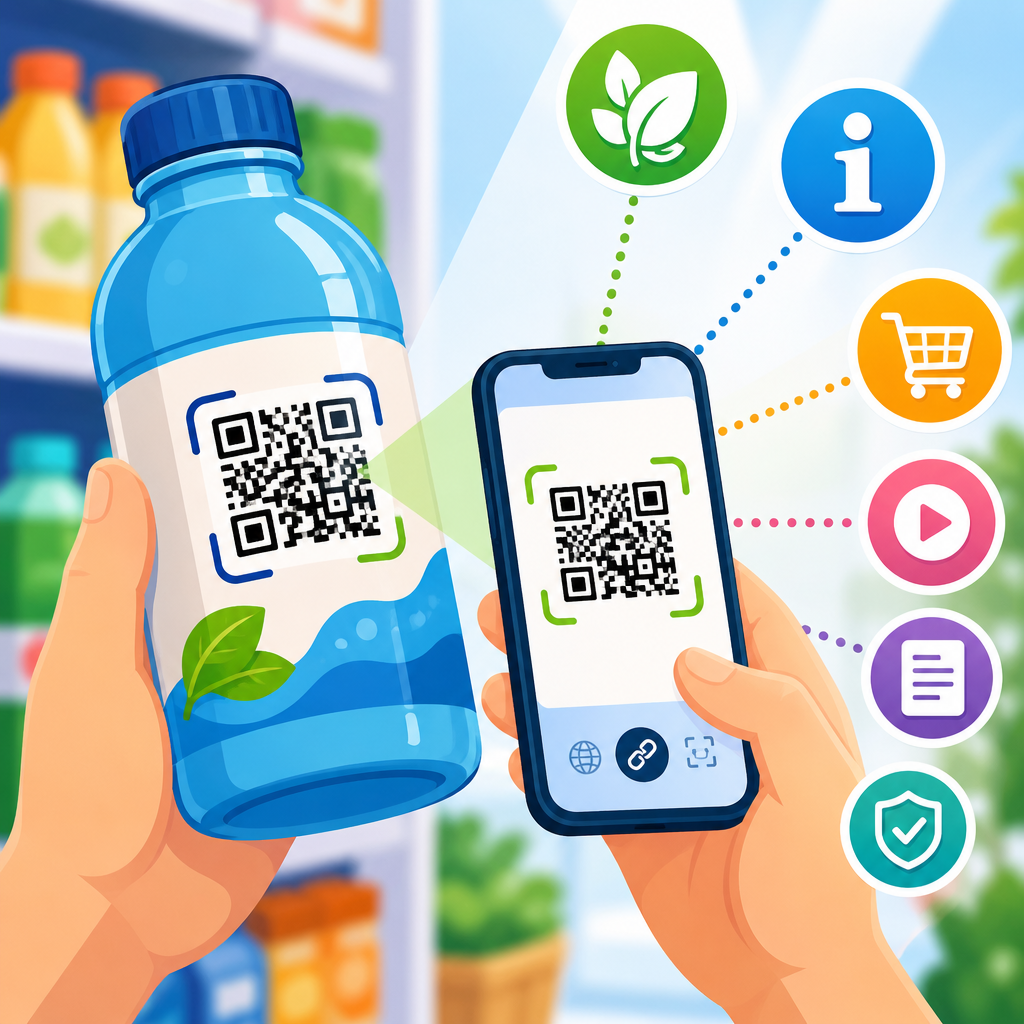
A GS1 Digital Link QR code on a product label is a two-dimensional barcode that connects a scanned package to standardized online product data, brand content, regulatory details, and supply chain information through a web address structure defined by GS1. It matters because one code can serve shoppers, retailers, logistics teams, marketplaces, and regulators at the same time, replacing the long-standing split between a consumer-facing QR code and a separate point-of-sale barcode. For brands preparing for the retail industry’s shift beyond the traditional UPC and EAN, understanding this format is no longer optional.
I have helped companies evaluate packaging changes for this transition, and the first challenge is usually terminology. GS1 is the global standards body behind GTINs, UPCs, EANs, SSCCs, and other identifiers used in commerce. A Digital Link is a standards-based way to express those identifiers in a web URI so software can resolve them to useful destinations. A QR code is simply the carrier: the square symbol printed on pack. Put together, a GS1 Digital Link QR code encodes a standards-compliant web link that can include a GTIN, batch or lot number, serial number, expiration date, weight, and other attributes in a machine-readable format.
This article is the hub for understanding QR code types in product labeling, with GS1 Digital Link at the center because it is quickly becoming the most important format for packaged goods. It also explains how this code compares with static QR codes, dynamic QR codes, URL QR codes, vCard QR codes, app download QR codes, coupon QR codes, and legacy retail barcodes. If you need a clear answer to what goes on the label, what scanners can read it, and why brands are adopting it, this guide covers the essentials in plain language.
How a GS1 Digital Link QR Code works on packaging
At the simplest level, the code contains a web address built from GS1 rules. The path includes an identifier such as a GTIN, often shown in the Digital Link syntax as an application identifier paired with the number. When scanned, a phone camera or compatible scanner reads the symbol and opens or resolves the link. That resolution layer can direct different users to different resources. A shopper may see ingredients, allergens, sustainability claims, assembly videos, or loyalty content. A warehouse scanner may capture the GTIN plus batch and expiry. A hospital system may validate a serialized medical item. The printed symbol stays the same while the response can vary by context.
This is the major difference from a basic static QR code that points to one fixed landing page. A static code can still be useful for promotions, menus, support pages, and simple product education. However, it lacks the structured semantics that enterprise systems use for identification and traceability. A GS1 Digital Link QR code is not just “a QR code with a URL.” It is a standards-based identity layer for products and trade items. That distinction is why retailers, marketplaces, and solution providers treat it differently from ordinary marketing QR codes.
The retail industry’s migration path is often described around the Sunrise 2027 initiative, a coordinated push for point-of-sale systems to be capable of reading two-dimensional barcodes carrying GS1 data. The practical implication for brands is significant. Instead of printing a UPC for checkout and a separate QR code for consumers, companies can move toward one symbol that supports both use cases, provided the trading partners’ scanners and software are ready. Adoption will not happen evenly across all categories and regions, but the direction is established.
Why brands are replacing basic product QR codes with GS1 Digital Link
Brands adopt GS1 Digital Link QR codes for four reasons: better consumer experiences, better product data governance, stronger traceability, and operational efficiency. On the consumer side, one scan can answer common questions instantly: What is this product? Is it authentic? Where was it made? What allergens does it contain? How do I recycle the packaging? Those answers can change by market, language, or campaign without changing the printed code when the brand uses a resolver and dynamic content rules.
On the data side, GS1 identifiers provide a common language across systems. A GTIN ties the package to master data in ERP, PIM, marketplace feeds, and retailer catalogs. If the Digital Link also carries lot, serial, or expiry data, it becomes useful for recalls, markdown decisions, and compliance workflows. I have seen brands reduce confusion internally simply by aligning packaging teams, regulatory teams, and e-commerce teams around one identifier strategy instead of separate QR campaigns managed in isolation.
Operationally, fewer symbols on pack can save space, reduce design clutter, and simplify governance. That benefit is especially important for small labels in cosmetics, supplements, medical devices, and food packaging, where multilingual regulations already compete for space. There are tradeoffs, though. Brands need resolver infrastructure, disciplined data quality, packaging artwork updates, and testing across scanners. A poorly implemented Digital Link can create friction if the code resolves slowly, opens irrelevant pages, or conflicts with retailer requirements.
GS1 Digital Link compared with other types of QR codes
Not every QR code belongs on a product label for the same reason. Some are built for identity, some for convenience, and some for campaigns. The right choice depends on whether the label must support checkout, traceability, changing destinations, or simple consumer engagement. The table below summarizes the most common QR code types discussed in packaging projects.
| QR code type | Primary purpose | Best use on product labels | Main limitation |
|---|---|---|---|
| GS1 Digital Link QR code | Standardized product identification and web resolution | Retail products needing checkout readiness, traceability, and rich consumer content | Requires GS1 identifiers, resolver setup, and implementation discipline |
| Static URL QR code | Open one fixed webpage | Simple campaigns, instructions, menus, support pages | Destination cannot be changed without reprinting |
| Dynamic QR code | Redirect through a managed short link | Marketing campaigns, A/B testing, scan analytics | Usually proprietary and not a product identification standard |
| vCard QR code | Share contact details | Business cards, sales collateral, trade shows | Not suitable for retail product identity |
| App download QR code | Send users to app stores | Connected devices, loyalty ecosystems, warranty apps | Creates an extra step before product information is reached |
| Coupon or promo QR code | Deliver offers or redemption flows | Limited-time promotions and in-store campaigns | Often disconnected from core product data |
The important takeaway is that GS1 Digital Link is not replacing every QR code use case. A vCard code still belongs on a salesperson’s card, and a short-term event campaign may still use a dynamic marketing code. But for the package itself, especially in consumer goods, food, health, and regulated categories, the standards-based option is increasingly the strategic choice because it connects the physical item to digital systems in a reliable, interoperable way.
What data can be encoded in a GS1 Digital Link QR code
The core identifier is usually the GTIN, the globally unique product number already used across retail. Beyond that, brands can include application identifiers for attributes such as batch or lot number, serial number, expiration date, production date, count, weight, and more, depending on the use case. This structure matters because scanners and enterprise software can parse the fields consistently. In food, lot and expiry can support recall precision and waste reduction. In pharmaceuticals and medical devices, serial and lot data support verification and patient safety. In apparel or consumer electronics, serialized identity can help with authentication, warranty, and resale.
Not every implementation encodes every possible field. More data increases utility, but it also affects symbol size, print quality requirements, and process complexity. Packaging engineers need to balance capacity, module size, quiet zone, substrate limitations, and the scanning environment. A code printed on curved flexible packaging behaves differently from one printed on a flat carton. Dark backgrounds, gloss coatings, and low contrast can reduce readability. The standard gives the structure, but good production practice determines whether the code performs well in stores and in consumers’ hands.
How smartphones, retail scanners, and software interpret the code
A modern smartphone usually treats the symbol as a scannable link and opens the destination in a browser. Behind the scenes, the resolver can read the incoming request and decide what to return. If the user is in France, the page can open in French. If the scan comes from a trade app with authenticated credentials, the response can include B2B data not shown to the public. This flexibility is one reason Digital Link is attractive for omnichannel commerce.
Retail scanners are different. For point-of-sale use, the scanner and POS software must decode the symbol, extract the necessary identifier, and process it as an item record, just as they would with a UPC or EAN. Many retailers are upgrading equipment and software in phases. Some can already read QR symbols in controlled pilots; others still depend mainly on linear barcodes. During transition, brands often keep both the traditional barcode and the GS1 Digital Link QR code on the pack. That dual-marking approach is common and sensible until trading partner readiness is confirmed.
Implementation basics: what brands need before putting one on pack
Successful implementation starts with a licensed GS1 company prefix or other legitimate access to GS1 identifiers, depending on the numbering structure. Next comes clean product master data. If the GTIN points to inconsistent records across ERP, PIM, e-commerce, and regulatory systems, the code will expose those inconsistencies quickly. After data hygiene, the brand needs a resolver strategy. Some companies build their own domain and routing rules; others use packaging and connected product platforms that support GS1 Digital Link resolution. Common tools in these programs include GS1 registries, digital asset management systems, product information management platforms, and analytics dashboards.
Testing is non-negotiable. Verify print quality using ISO/IEC barcode quality methods, test scans across iPhone and Android devices, and validate behavior with retailer or distributor hardware where possible. Also review governance: who owns the destination rules, who updates consumer content, how redirects are monitored, and what happens if a linked page is retired. In my experience, the technical build is often easier than the organizational alignment. The strongest projects assign clear ownership across packaging, IT, marketing, regulatory, and supply chain teams.
Common product label use cases across industries
Food and beverage brands use GS1 Digital Link QR codes to provide ingredients, allergens, nutritional information, recipe ideas, provenance stories, and recycling guidance while also supporting lot-level traceability. Beauty brands use them for ingredient glossaries, usage tutorials, shade matching, and counterfeit detection. Consumer electronics companies connect products to setup guides, firmware notices, warranty registration, and spare-part lookup. In healthcare, the value is even more concrete: verified identity, lot control, expiration awareness, and standardized data exchange can directly improve safety and efficiency.
These examples show why this article sits at the center of a broader “types of QR codes” topic. Product labels are no longer just printed surfaces; they are digital entry points. Yet the best QR code type depends on the job. If the goal is basic contact sharing, use a contact code. If the goal is a temporary promotion, a managed campaign code may be enough. If the goal is durable product identity with interoperability across the supply chain and consumer channels, a GS1 Digital Link QR code is the correct architecture.
Limitations, compliance considerations, and future outlook
GS1 Digital Link is powerful, but it is not magic. It does not fix poor product data, weak governance, or bad packaging print quality. It also does not guarantee that every retailer, scanner, marketplace, and mobile device will use the data exactly the same way. Brands operating globally must account for local regulations on disclosures, claims, privacy, and language. If scan analytics involve cookies, user tracking, or geolocation, privacy review is essential. Accessibility also matters: linked pages should be mobile-friendly, fast, and readable by assistive technologies.
The long-term outlook is strong because the commerce ecosystem benefits from a shared, internet-native identification method. As retailer readiness increases, more brands will consolidate package barcodes and consumer engagement into one symbol. The winners will be the companies that treat the code as infrastructure, not decoration. They will maintain clean identifiers, accurate landing content, strong resolver performance, and clear governance from packaging design through post-purchase support.
A GS1 Digital Link QR code on a product label is best understood as the next generation of product identification: a scannable symbol that unites standardized item data, web content, and operational intelligence in one format. For consumers, it makes product information easier to access. For brands, it creates a governed bridge between packaging, commerce systems, and digital experiences. For retailers and regulators, it supports better data capture, traceability, and consistency.
If you are building out a QR code strategy under the broader topic of QR Code Basics and Education, start here. Map your label use cases, identify which QR code types serve each purpose, and prioritize GS1 Digital Link wherever durable product identity matters. Then test it thoroughly with your packaging, data, and retail workflows. One well-implemented code can do far more than send a shopper to a webpage; it can become the foundation of smarter product communication across the entire lifecycle.
Frequently Asked Questions
What is a GS1 Digital Link QR code on a product label?
A GS1 Digital Link QR code is a two-dimensional barcode that carries a web-based identifier built using GS1 standards. In simple terms, it turns a product’s barcode into a scannable link that can connect the package to trusted online information. Instead of encoding only a product number for checkout, it can point to a structured web address that includes the product’s GS1 identification data, such as a GTIN, and can also support additional details like batch or lot numbers, serial numbers, expiration dates, and other attributes when needed.
What makes it different from a standard QR code is the standardized format behind the link. A normal QR code can send a user to almost any URL, but a GS1 Digital Link QR code follows rules defined by GS1 so the data inside the code is consistent, interoperable, and meaningful across systems. That means the same code can be interpreted by retailers, marketplaces, mobile apps, logistics platforms, and brand systems without each party having to guess what the code means.
On a product label, this creates a bridge between the physical item and digital product information. When scanned, the code can lead shoppers to product pages, ingredients, usage instructions, sustainability details, promotions, or support content. At the same time, businesses can use the same symbol to support inventory management, traceability, compliance, and operational workflows. That dual purpose is one of the main reasons GS1 Digital Link is getting so much attention.
How is a GS1 Digital Link QR code different from a traditional barcode or a regular QR code?
A traditional retail barcode, such as a UPC or EAN, is designed primarily for point-of-sale scanning. Its main job is to communicate a product identifier quickly and reliably at checkout. It works extremely well for pricing and inventory, but it has limited ability to connect users to richer digital content or to carry broader context around the product. That is why many brands historically added a separate consumer-facing QR code somewhere else on the package for marketing or engagement.
A regular QR code solves the link-to-content problem, but it is not automatically standardized for product identification. One brand might encode a campaign page, another might encode a product page, and another might use a redirect link with no clear data structure. Regular QR codes can be useful, but they do not inherently create a common language that retailers, regulators, and supply chain partners can rely on at scale.
A GS1 Digital Link QR code combines the strengths of both approaches. It can identify the product using globally recognized GS1 standards while also functioning as a gateway to online content. Because the code follows a standardized web address structure, scanners and software can recognize the product identity in a consistent way, while still allowing different users to access different experiences. A shopper may see product education, a retailer may validate item data, and a logistics team may retrieve traceability information, all starting from the same symbol on the package.
This matters because it helps replace the long-standing split between one barcode for checkout and another code for digital engagement. As the industry moves toward next-generation barcodes, brands can use one smarter code to support more use cases across commerce, compliance, and customer experience.
Why are brands, retailers, and supply chain teams adopting GS1 Digital Link QR codes?
The biggest reason is efficiency. A GS1 Digital Link QR code allows one code to serve multiple audiences at the same time. For brands, that means less packaging clutter and a more flexible way to share up-to-date product information without redesigning labels for every market or campaign. For retailers, it creates a path toward richer item data and more advanced scanning capabilities. For supply chain teams, it supports better traceability, authentication, and operational visibility.
Another major driver is the growing demand for transparency. Consumers increasingly expect to access ingredients, allergen information, sourcing details, instructions, recycling guidance, and brand trust content instantly from the package. Regulators and trading partners also want clearer, more accessible product data. A GS1 Digital Link QR code helps meet these expectations by connecting the physical product to authoritative digital records in a standardized way.
It is also important for future-readiness. Many organizations are preparing for a next-generation barcode environment in which 2D barcodes can be scanned at retail point of sale and throughout the supply chain. This shift supports use cases that one-dimensional barcodes cannot handle as easily, such as encoded expiration dates for food waste reduction, serialized identification for traceability, and lot-level data for recalls. Brands that prepare early are often in a stronger position to adapt packaging, data systems, and retail partnerships as adoption expands.
Finally, GS1 Digital Link supports better control over digital experiences. Because the code points into a standards-based web framework, brands can manage where users are directed, localize content by geography or language, and update destination pages over time. That makes the code useful not just as an identifier, but as a long-term digital connection point between the product and every stakeholder who interacts with it.
What kind of information can a GS1 Digital Link QR code provide when someone scans it?
The answer depends on who is scanning it and how the brand or data owner has configured the experience. For consumers, the code can open product pages with ingredients, nutrition facts, how-to videos, care instructions, safety information, warranty details, FAQs, or promotions. It can also support transparency use cases such as sustainability claims, sourcing stories, recycling instructions, certifications, and accessibility content. In many cases, this is far more useful than what can fit on a small label.
For retail and marketplace environments, the same code can support access to structured product data such as identifiers, dimensions, pack hierarchies, images, and attribute information. This can improve listing quality, item matching, and data consistency across channels. For logistics and supply chain teams, the code may help with traceability, receiving, inventory workflows, returns, verification, and recall management, especially when additional identifiers like lot, batch, serial, or date information are included.
For regulated industries, the code can also play a role in compliance and record access. Depending on the product category and market, that may include links to regulatory disclosures, safety sheets, product documentation, or other required digital resources. One of the key advantages is that the destination can be dynamic and context-aware. A scan from a shopper’s phone might show consumer content, while a scan in an enterprise system might resolve to machine-readable data or operational information.
In other words, the code is not limited to a single webpage. It is better understood as a standards-based access point to relevant product information. That flexibility is exactly why it is so valuable on modern product labels.
Do GS1 Digital Link QR codes replace existing product barcodes right away?
Not always, and in many cases not immediately. Adoption is a transition rather than an overnight switch. While GS1 Digital Link QR codes are designed to support both product identification and digital engagement, real-world deployment depends on scanner readiness, retailer capabilities, packaging constraints, software integration, and the specific markets where products are sold. Many brands begin by adding the 2D code alongside existing linear barcodes while systems across the value chain are updated.
This phased approach is practical because point-of-sale environments, warehouse systems, mobile apps, and trading partners may not all be ready at the same time. During the transition, companies often need to ensure that legacy scanners can still read the required barcode for checkout, while newer devices and applications can take advantage of the added capabilities of the GS1 Digital Link QR code. Over time, as more ecosystems support 2D barcode scanning, the need for separate symbols can decrease.
For brands preparing now, the real opportunity is strategic planning. That includes reviewing packaging space, verifying GS1 identifiers, improving product data quality, aligning internal teams, and deciding which user journeys the code should support. It also means understanding how to manage resolution rules so different scanners and audiences reach the right information. Brands that treat the code as part of a broader data and packaging strategy tend to get the most value from it.
So while a GS1 Digital Link QR code may eventually help consolidate functions that were once split across multiple symbols, most organizations should view it as an evolution. The goal is not simply to print a new code, but to build a smarter, standards-based product label that can serve commerce, consumers, and compliance in a much more connected way.