QR codes are now woven into everyday life, appearing on restaurant tables, product boxes, payment terminals, event tickets, utility bills, factory labels, and medical forms because they solve a simple problem efficiently: they connect a physical object to digital information in seconds. A QR code, short for Quick Response code, is a two-dimensional barcode that stores data in a pattern of black and white modules readable by smartphone cameras, handheld scanners, and industrial imaging systems. Unlike traditional one-dimensional barcodes that usually encode a short product number, QR codes can hold website links, contact details, Wi-Fi credentials, serial numbers, payment instructions, authentication tokens, and workflow data. I have implemented QR code systems for marketing campaigns, inventory programs, and customer support portals, and their value is consistent across industries: they reduce friction at the exact moment a person needs information or needs to complete an action.
Understanding what QR codes are and what they are used for matters because the technology sits at the intersection of offline behavior and digital engagement. When someone asks, “What are the main uses of QR codes today?” they usually also mean: how do QR codes work, where are they most effective, what kinds of data do they carry, and when should a business use a static code versus a dynamic one? This hub article answers those questions directly and provides a clear foundation for the broader QR Code Basics & Education topic. It explains the most important modern use cases, from payments and product packaging to healthcare, logistics, and customer service, while also covering the practical limits that determine whether a QR deployment succeeds or fails in the real world.
What QR codes are and how they work
A QR code is a matrix barcode invented by Denso Wave in 1994 for tracking automotive components more efficiently than conventional barcodes. Its design includes finder patterns in three corners so a scanner can detect orientation quickly, alignment patterns to maintain readability on distorted surfaces, timing patterns to map the grid, and encoded data plus error correction. Error correction is one reason QR codes are so resilient: depending on the level used, a code can often remain scannable even if part of it is scratched, obscured, or printed on curved packaging. Common standards include ISO/IEC 18004, and most modern smartphones decode standard QR symbols natively through built-in camera apps.
In practical terms, a QR code works by encoding characters into a machine-readable pattern. The scanner interprets the modules, applies error correction, and then triggers the intended action, such as opening a URL or displaying text. There are two broad categories. Static QR codes contain fixed data and cannot be changed after printing. Dynamic QR codes point to a short redirect URL or managed record, allowing the destination to be updated later while keeping the printed code the same. Dynamic systems also enable scan analytics such as time, approximate location, device type, and campaign source. That flexibility is why dynamic codes dominate business use cases, while static codes are still common for simple tasks like sharing Wi-Fi access or a digital contact card.
Main consumer uses of QR codes today
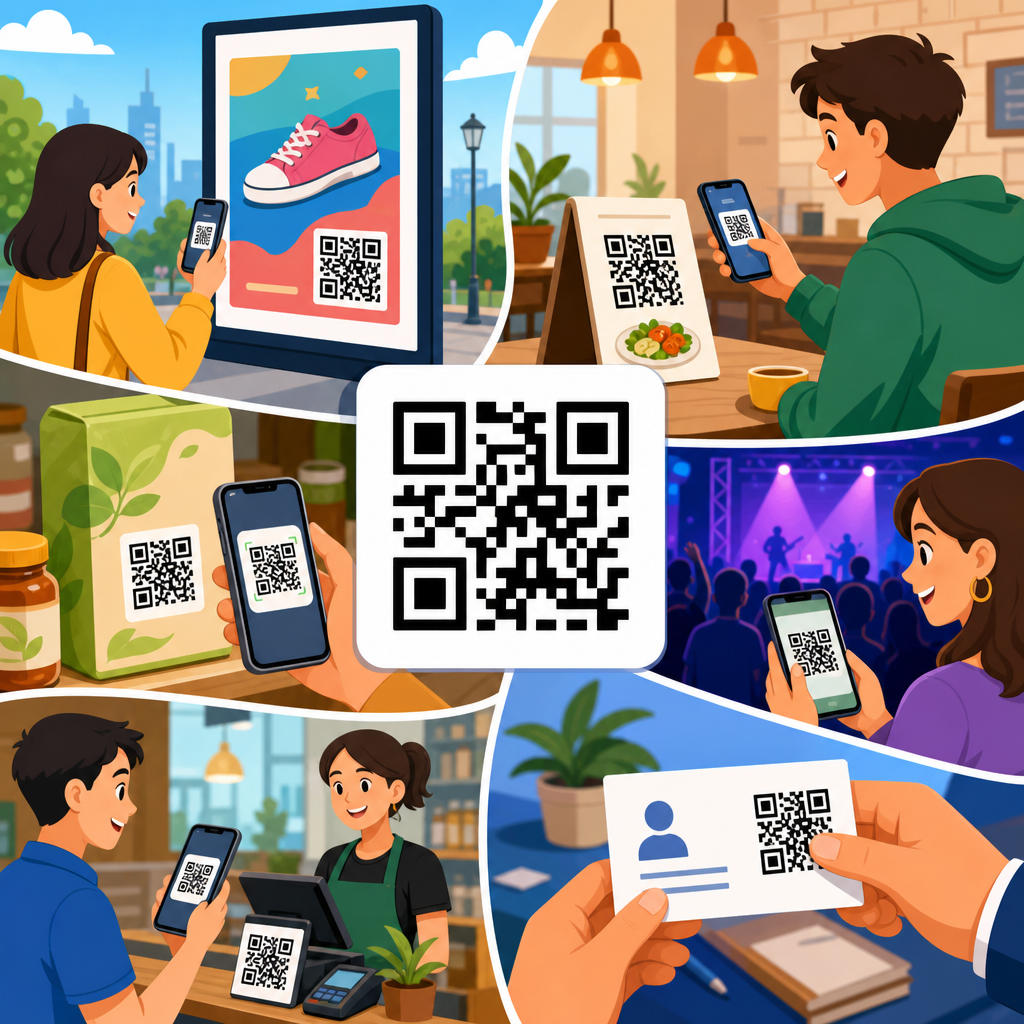
The most visible QR code uses are consumer-facing. Restaurants use them for menus, ordering, and table payments. Retailers place them on shelves and product packaging so shoppers can access ingredients, manuals, assembly videos, warranty registration, and sustainability claims. Service businesses add QR codes to receipts and signage to collect reviews or direct customers to support resources. Real estate agents place codes on yard signs linking to listing pages, video tours, and scheduling tools. Museums and tourist sites use them beside exhibits to provide multilingual context, audio guides, and accessibility features without printing extensive physical materials.
Payments are one of the strongest modern use cases. In many markets, QR-based payments became mainstream because they lower hardware costs and support both merchant-presented and customer-presented transactions. A café can display a printed code for a wallet app, while a customer can present a code generated on a banking app for scanning at checkout. Systems such as Alipay, WeChat Pay, UPI apps in India, and many bank wallets normalized this behavior at massive scale. The appeal is straightforward: no card terminal is required for the simplest implementations, payment details are transferred accurately, and small businesses can start accepting digital payments quickly.
Marketing teams also rely on QR codes because they bridge print and digital with measurable results. I have used them on direct mail pieces, in-store displays, trade show booths, and packaging inserts to send users to campaign landing pages tailored to the exact source. A code on a brochure can open a product demo, while a code on a conference badge can exchange contact details or launch an event app. The best-performing campaigns usually pair a clear call to action with a destination optimized for mobile, because the scan is only the first step; if the landing page is slow or confusing, the value of the code disappears immediately.
Business, operations, and industrial applications
Beyond consumer marketing, QR codes are heavily used inside business operations. In warehouses and manufacturing facilities, teams apply codes to bins, pallets, work orders, tools, and equipment to accelerate tracking and reduce manual entry errors. A maintenance technician can scan a machine label to retrieve service history, parts lists, lockout procedures, and inspection checklists. On production lines, a QR code can tie a component batch to timestamps, operator records, and quality-control results, improving traceability. Compared with typing long serial numbers, scanning is faster and usually more accurate, especially in environments where speed and precision directly affect cost.
Logistics providers use QR codes for shipment identification, proof of delivery workflows, return merchandise authorizations, and customer self-service. E-commerce brands often include a QR code in the box or on the packing slip that opens returns instructions, setup guides, or a support chat. This reduces avoidable support tickets and gives the customer a clear post-purchase path. In document management, firms attach QR codes to files, invoices, and forms so staff can retrieve the right record instantly from a content system. Law firms, healthcare administrators, and field service teams use this approach because paper still exists in critical workflows, and the code acts as a reliable bridge to the current digital record.
Authentication and anti-counterfeiting are another significant business use. Brands serialize products and assign unique QR codes so each unit can be verified during distribution or by the end customer. When paired with a secure database, the scan can confirm whether a code is genuine, already redeemed, or geographically inconsistent with expected distribution. This is not foolproof on its own, because visible codes can be copied, but it becomes much more robust when combined with one-time redemption, tamper-evident packaging, hidden identifiers, or cryptographic signatures. Pharmaceuticals, cosmetics, electronics accessories, and luxury goods increasingly use QR-linked verification to strengthen trust and improve recall readiness.
Education, healthcare, and public services
Education adopted QR codes because they simplify access without requiring users to type long links. Teachers place them on worksheets, classroom walls, library shelves, and lab stations to connect students to videos, assignments, readings, safety instructions, or interactive quizzes. Universities use them for event check-ins, campus maps, digital ID workflows, and equipment lending. In practice, QR codes are most effective in education when they remove a clear point of friction, such as typing a complex URL from a projector screen or finding the right learning resource among many similar pages. They are much less useful when added simply as decoration with no obvious next action.
Healthcare uses are equally practical. Clinics and hospitals deploy QR codes for patient intake forms, appointment confirmations, medication information, vaccination records, device instructions, and wayfinding. A discharge packet can include a code linking to aftercare steps in multiple languages, reducing confusion once the patient leaves the facility. Medical device manufacturers place QR codes on equipment and packaging to support identification, documentation, and recall management. Public health agencies also use them for service directories and informational campaigns. In every healthcare setting, the core requirement is not novelty but clarity, privacy, and accuracy: the code must lead to a secure, mobile-friendly destination with language patients can understand.
Government and public services use QR codes for forms, permit payments, transit information, tourism assistance, and emergency communications. During service disruptions, agencies can place temporary signage with codes linking to live updates rather than printing changing information repeatedly. Libraries use them to connect patrons to catalog entries, digital collections, and self-service registration. Transit operators print them on timetables, posters, and tickets so riders can see route maps or validate fare products. These implementations work well because they shorten the distance between a physical touchpoint and a timely answer, especially when staff resources are limited or the information changes frequently.
Choosing the right QR code strategy
Not every QR code project delivers value. The difference between a helpful implementation and a useless one usually comes down to destination quality, placement, sizing, contrast, governance, and analytics. A code should point to content or an action that is relevant in that exact context. On packaging, that might be setup instructions or authenticity verification. On a retail sign, it might be local inventory or financing options. On a business card, it might be a vCard or booking page. If users must pinch, wait, search, or re-enter data after scanning, the design has failed. Good QR strategy minimizes post-scan effort.
The table below shows the most common QR code uses today and the practical benefit each one delivers.
| Use case | Typical destination | Main benefit |
|---|---|---|
| Restaurant service | Menu, ordering page, payment link | Faster table turnover and lower printing costs |
| Retail packaging | Manual, warranty, ingredients, video | Better product education after purchase |
| Payments | Wallet or bank payment request | Low-cost digital transactions |
| Events | Ticket validation, schedule, lead capture | Quicker check-in and cleaner data collection |
| Operations | Asset record, checklist, service log | Reduced manual entry errors |
| Healthcare | Forms, aftercare instructions, records | Improved access to timely patient information |
| Authentication | Product verification page | Stronger trust and traceability |
Technical execution matters. Print quality must be high enough for the code to scan under realistic conditions, including glare, distance, motion, and lower-end phone cameras. Quiet zone spacing around the symbol is essential, and dark modules on a light background remain the safest choice. Dynamic links should be managed through a reliable platform with HTTPS, access controls, expiration rules where appropriate, and reporting that respects privacy obligations. Teams should test across iPhone and Android devices before launch. For advanced programs, URL parameters can be used to distinguish placement sources, while redirects can preserve a clean user experience and centralized control.
There are also clear limits. QR codes depend on camera access, reasonable lighting, and a user willing to scan. They are less effective where connectivity is poor, where the destination is not mobile optimized, or where the audience has no reason to trust the link. Security concerns are real because malicious actors can overlay fraudulent codes on public surfaces or direct scans to phishing pages. That is why branded domains, visible destination cues, tamper checks, and routine inspections matter for public deployments. Businesses should treat QR codes as a user interface, not as decoration. The code itself is only the doorway; trust, relevance, and speed determine whether people walk through it.
QR codes remain important because they solve a broad set of modern problems with minimal hardware, familiar user behavior, and strong flexibility. They identify, instruct, verify, route, measure, and transact. For consumers, they reduce friction between seeing something and acting on it. For businesses, they connect physical environments to digital systems without forcing manual typing or expensive custom infrastructure. The main uses of QR codes today span payments, menus, packaging, marketing, logistics, healthcare, education, public service, and product authentication, but the underlying principle is the same in every case: instant access to the right information or action at the right moment.
As a hub for understanding what QR codes are, this page establishes the basics that support every deeper topic in QR Code Basics & Education. If you are deciding whether to use QR codes, start by identifying one user task that should become faster, clearer, or more measurable. Then choose the right code type, test the scan experience on real devices, and make sure the destination genuinely helps the user. Done well, QR codes are not a trend feature; they are a durable operational tool. Use this foundation to evaluate your next QR project and build from a practical, evidence-based plan.
Frequently Asked Questions
What are the most common uses of QR codes today?
QR codes are used across many industries because they make it easy to connect a physical item or printed surface to digital content almost instantly. In everyday consumer settings, one of the most familiar uses is menu access in restaurants, where customers scan a code on the table to view dishes, prices, and ordering options on their phones. Retailers place QR codes on product boxes, shelf tags, and packaging so shoppers can open product specifications, user guides, warranty details, ingredient lists, promotions, and brand videos without typing in a web address. Payment is another major use case, especially in stores, cafes, and peer-to-peer transactions, where a scan can launch a secure digital payment workflow in seconds.
Beyond consumer convenience, QR codes are heavily used in events, logistics, manufacturing, healthcare, education, and public services. Event organizers use them on tickets for fast check-in and fraud reduction. Delivery companies and factories apply them to labels so workers can track inventory, confirm shipments, identify components, and access production records. Healthcare providers use them on forms, wristbands, prescriptions, and patient materials to speed up identification and connect staff or patients with important information. Utility companies often print QR codes on bills so customers can pay online or review account details immediately. What ties all of these examples together is the same core benefit: a QR code lets someone move from the physical world to the right digital destination quickly, accurately, and with very little friction.
Why have QR codes become so popular in everyday life?
QR codes have become popular because they solve a simple but widespread problem better than many older methods: they remove the need to manually enter long URLs, serial numbers, payment references, or product information. Instead of typing, searching, or navigating through a website, a person can just point a smartphone camera at the code and reach the intended content in seconds. That convenience matters in busy real-world environments such as checkout counters, restaurant tables, transportation hubs, offices, clinics, warehouses, and event entrances, where speed and accuracy are important.
Another reason for their growth is that the technology fits naturally into devices people already carry. Most modern smartphones can scan QR codes through the built-in camera, so users usually do not need a separate app or specialized training. Businesses also like QR codes because they are inexpensive to create, easy to print on almost any surface, and flexible enough to support many goals, including payments, marketing, product education, authentication, registration, and tracking. In addition, they work well in both small-scale and industrial settings, from a flyer in a coffee shop to a component tag in a factory. Their popularity is ultimately the result of practicality: QR codes are fast, low-cost, easy to deploy, and effective at linking offline interactions with digital systems.
How are QR codes used in business, manufacturing, and logistics?
In business operations, QR codes are often used to improve efficiency, reduce errors, and make information easier to access at the point where it is needed. Offices and service businesses use them for things like digital forms, customer feedback surveys, appointment check-ins, onboarding materials, and quick access to support resources. In retail and product-based businesses, QR codes on packaging can direct customers to setup instructions, troubleshooting pages, return policies, loyalty programs, or product registration pages. This not only improves customer experience but also reduces the need for large printed manuals and makes it easier to keep information current.
In manufacturing and logistics, QR codes are especially valuable because they can store identifying data and be scanned quickly in fast-moving environments. A code on a factory label might link a part to its batch number, production date, inspection record, assembly instructions, or maintenance history. In warehouses and shipping operations, QR codes help workers identify items, verify picks, update inventory systems, trace shipments, and confirm delivery milestones. Because scanners and imaging systems can read them reliably, they support automation as well as human workflows. This makes QR codes a practical tool for traceability, quality control, inventory accuracy, and supply chain visibility. In sectors where timing and precision matter, that combination of speed and reliability is a major advantage.
Are QR codes mainly used for marketing, or do they serve practical everyday functions too?
QR codes are often associated with marketing, but their practical everyday uses are just as important, and in many cases even more significant. On the marketing side, they are useful because they help businesses bridge printed and digital channels. A code on a poster, brochure, display, package, or advertisement can send users to a landing page, video, coupon, app download, contest, social profile, or campaign-specific offer. This makes it easier to measure engagement and encourages immediate action from people who are already interested in what they see.
At the same time, many of the most valuable uses of QR codes are operational and functional rather than promotional. People scan QR codes to pay bills, validate tickets, check in for appointments, access instruction manuals, review medical forms, verify products, connect to Wi-Fi, and retrieve service information. In these cases, the code is not just a marketing tool; it is part of the service itself. That distinction matters because it shows why QR codes have remained widely relevant. They are not limited to advertising campaigns or temporary promotions. They are now embedded in daily routines because they help complete real tasks faster, with less confusion and fewer manual steps.
Are QR codes safe to use, and what should people watch out for?
QR codes are generally safe when they come from trusted sources, but like any tool that opens digital links, they should be used with basic caution. The code itself is simply a machine-readable way to store data such as a website address, payment request, contact details, or identifier. The real safety question is where that code leads. A legitimate QR code on official packaging, a utility bill, an event ticket, or a verified payment terminal is usually part of a normal and secure process. Problems arise when malicious actors place fake codes over real ones, use codes to direct people to phishing websites, or try to trick users into sending payments to the wrong destination.
The best approach is to treat QR code scanning the same way you would treat clicking a link in an email or text message. Check the source, look closely at the web address before submitting personal information, and be cautious if a scan immediately asks for login credentials, payment details, or downloads. In public places, it is wise to watch for tampered stickers placed over original codes. Businesses can improve trust by using branded materials, secure domains, and clear instructions so users know what to expect after scanning. When used responsibly, QR codes are a safe and efficient technology, but users should still pay attention to context and verify that the destination appears legitimate before taking action.