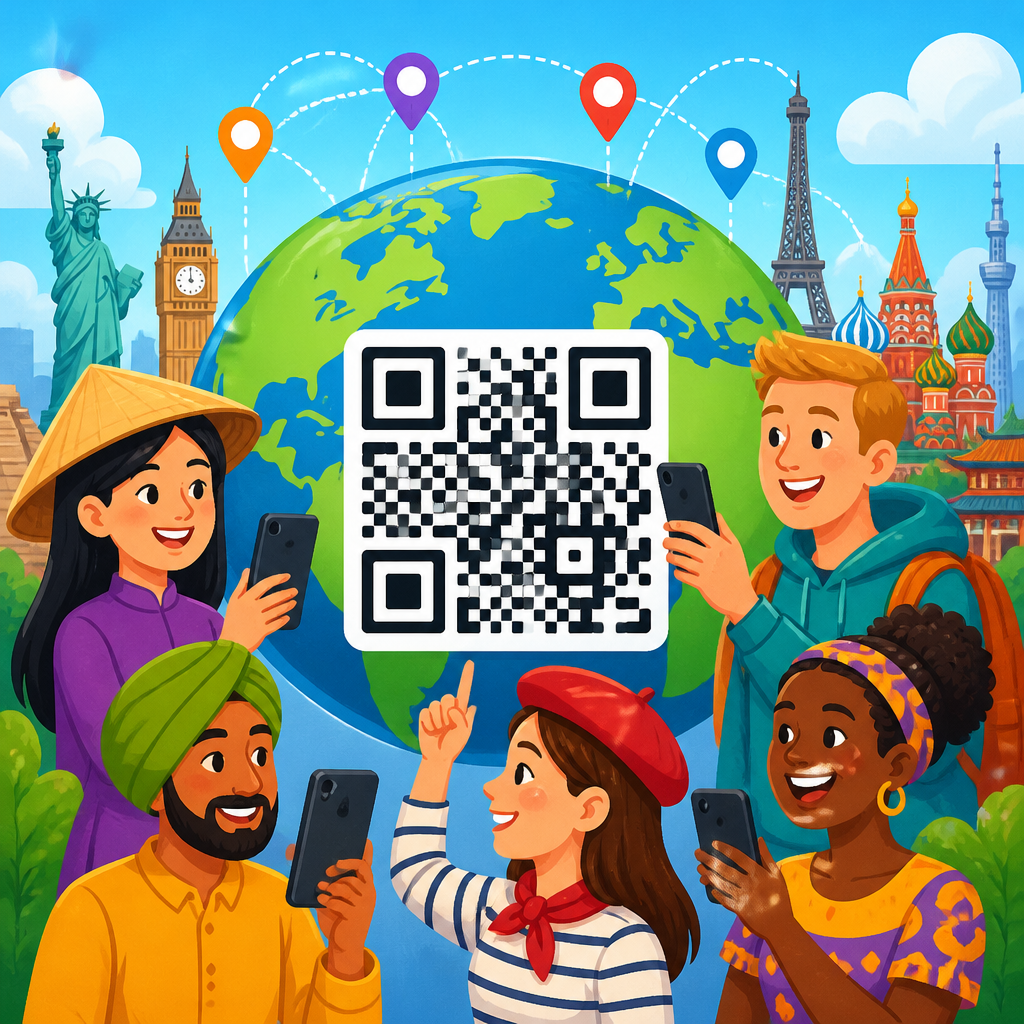
QR codes work across countries and different languages because the symbol stores machine-readable data, not human language, and any compatible scanner can decode it anywhere. That simple fact makes the quick response code one of the most practical bridges between print and digital content. In global campaigns, retail packaging, tourism, payments, logistics, and product support, I have seen the same black-and-white square perform reliably from Tokyo train stations to Paris restaurant tables, provided the underlying destination is designed for international use. The code itself is universal; the experience after the scan determines whether it truly works for the user.
To understand why, it helps to start with what QR codes are. A QR code is a two-dimensional matrix barcode invented in 1994 by Denso Wave for tracking automotive components. Unlike a one-dimensional barcode, which stores data in a single line of varying widths, a QR code stores data both horizontally and vertically. That allows much higher capacity and faster reading. Standard QR codes can hold numeric, alphanumeric, byte, and kanji data, and they include Reed-Solomon error correction so scanners can still read partially damaged symbols. Those technical features explain why QR codes are now used for website links, Wi-Fi login, digital business cards, app downloads, event tickets, payment requests, menus, and inventory control.
This matters because many businesses assume a QR code automatically creates a global user experience. It does not. The code can be scanned in almost any market with a smartphone camera or scanning app, but cross-country performance depends on several linked factors: internet access, destination URL structure, language localization, redirects, app support, payment standards, and regulatory requirements. If the landing page fails to load outside one region, if the content appears only in one language, or if a dynamic code points to blocked services, the QR code has technically worked while the campaign has failed. For anyone learning QR code basics, that distinction is essential.
As the hub for understanding what QR codes are and how they function internationally, this guide explains the technology, what changes across borders, how language affects results, and what setup choices make a code useful worldwide. If you need a direct answer: yes, QR codes work across countries and different languages, but the scan destination, not the symbol alone, decides whether users actually succeed.
What Are QR Codes and How Do They Actually Work?
A QR code is a square matrix of modules arranged around three position detection patterns, usually visible as three larger squares in the corners. When a smartphone camera or industrial scanner reads the code, software identifies orientation, samples the grid, corrects distortion, and decodes the stored data. That data may be a plain URL, text string, contact card, SMS prompt, phone number, payment payload, or another standardized instruction. Because the data format is standardized under ISO/IEC 18004, QR codes are broadly interoperable across devices, operating systems, and countries.
In practice, most consumer QR codes contain a URL. Static QR codes encode the final destination directly and cannot be edited after printing. Dynamic QR codes usually encode a short redirect URL controlled through a QR code generator platform. I generally recommend dynamic codes for business use because they allow destination changes, scan analytics, campaign tagging, and conditional routing by device, time, or location. They also support operational fixes if a page breaks after materials are distributed. Static codes are still useful for permanent destinations such as Wi-Fi credentials, equipment labels, or simple signage where no future editing is needed.
Error correction is a major reason QR codes work well in real environments. The four common levels, L, M, Q, and H, restore increasing amounts of lost data, with H tolerating roughly 30 percent damage. That resilience allows codes on packaging, posters, receipts, and outdoor signs to remain scannable despite wear. However, higher error correction increases symbol density, which can reduce scan speed if the printed size is too small. In field testing, the most common failure is not language or geography but poor production: low contrast, glossy materials, tiny module sizes, or codes placed where cameras cannot focus easily.
Do QR Codes Work Across Countries?
Yes, QR codes themselves work across countries because the decoding standard is global. A camera in Brazil reads the same encoded pattern as a camera in Germany. What varies by country is everything around the scan. The user may face mobile network restrictions, roaming costs, captive portals, app availability, or region-specific browser behavior. A code printed in one market can therefore scan perfectly yet still produce a weak experience abroad if the destination assumes local conditions.
I have seen this most clearly with travel and packaging projects. A hotel welcome card may use a QR code linking to a local activities page hosted on a domestic platform that loads slowly from international networks. A cosmetic product sold in multiple regions may direct all users to a single English-language PDF, even though packaging regulations in the European Union, Gulf states, and Southeast Asia require different product information. In both cases, the symbol works everywhere, but the content strategy does not.
Country-specific legal and platform considerations matter too. Some services are blocked or limited in certain markets. Payment QR codes are especially regional. China widely uses Alipay and WeChat Pay formats, India relies heavily on UPI, and many European merchants use banking apps that support SEPA-linked or national schemes. A payment QR code that succeeds in one country may be useless in another unless the merchant supports a payment standard familiar to local users. The same is true for app-deep links, map services, and messaging platforms.
The simplest rule is this: if the destination can load on the user’s device, over the user’s network, in the user’s market, the QR code works internationally. If not, the problem is not the QR technology but the surrounding digital infrastructure.
Do QR Codes Work in Different Languages?
Yes, QR codes work in different languages because scanners interpret encoded data, not spoken or written language. A code can store a URL, Unicode text, or a structured payload regardless of whether the end user speaks English, Spanish, Arabic, Japanese, or Hindi. The more important question is whether the content after scanning is localized. If the landing page, form, menu, instruction sheet, or support article appears in the wrong language, users often abandon within seconds.
From a technical standpoint, QR codes can encode byte-mode data and support character sets that allow multilingual text. They can also store kanji efficiently using a dedicated mode. In reality, most global campaigns avoid placing long multilingual text directly in the symbol because dense codes become harder to scan. Instead, they encode a short URL and let the web server handle language selection through browser settings, IP-based hints, explicit language pickers, or region-specific paths such as /en/, /fr/, or /ja/.
Right-to-left languages and character rendering should be tested carefully. I have audited multilingual QR campaigns where the code scanned correctly but the Arabic landing page broke because the font stack lacked proper support or the page layout ignored bidirectional text rules. Similarly, tourism signage sometimes links to machine-translated pages that technically answer the query but fail to build trust. A QR code does not solve translation quality. It only creates access.
| Factor | Why It Matters Internationally | Best Practice |
|---|---|---|
| Encoded content | URLs are more flexible than long text for multilingual use | Use short dynamic URLs and manage language on the destination |
| Localization | Users abandon pages they cannot understand | Serve translated pages with clear language switching |
| Regional access | Some platforms or domains perform poorly by country | Use fast hosting, CDN support, and market testing |
| Payments and apps | QR payment standards vary widely by market | Match the code type to local user behavior |
| Print quality | Poor contrast and tiny modules hurt scanning everywhere | Maintain quiet zone, strong contrast, and adequate size |
What Makes a QR Code Successful Worldwide?
Successful international QR code deployment comes down to four things: scanability, accessibility, localization, and measurement. Scanability starts with design discipline. Maintain a proper quiet zone around the symbol, usually four modules wide. Use dark modules on a light background. Avoid excessive logo intrusion unless error correction has been tested. For print, size should match viewing distance; a common rule is about one inch of code width for every ten inches of scanning distance, though camera quality can expand the acceptable range. On packaging, I prefer conservative sizing because curved surfaces and reflective coatings reduce reliability.
Accessibility means giving users enough context to trust the scan. Label the code with a clear call to action such as “Scan for setup instructions” or “Scan for menu in 12 languages.” In many countries, users are now comfortable scanning QR codes, but they still hesitate when the destination is unclear. For security-sensitive sectors such as healthcare or finance, branded short domains and visible destination cues significantly improve confidence.
Localization is where many teams underinvest. A global QR strategy should not point every market to one generic page. Instead, create localized landing pages, translated product documentation, and region-specific compliance content. If language is detected automatically, always provide a manual override. Geo-routing should be a convenience, not a trap. Travelers, expatriates, and multilingual users often need a language that does not match their current IP location.
Measurement closes the loop. Dynamic QR platforms such as Bitly, QR Code Generator Pro, Beaconstac, and Flowcode can track scan counts, device types, time, and approximate location. Pair those insights with web analytics and UTM parameters to see which countries scan most, where users drop off, and which languages convert best. In one packaging rollout I worked on, scans from Spanish-speaking markets were strong, but completion rates lagged because the support article remained in English. Translating three core help pages improved completion substantially without changing the printed code.
Common Limitations, Misconceptions, and Best Uses
The biggest misconception is that a QR code is a marketing strategy. It is only a delivery mechanism. If the linked content is weak, slow, or irrelevant, the code adds friction rather than value. Another common misunderstanding is that one code should do everything. In reality, different use cases need different structures. A restaurant menu code should open instantly in a mobile browser with no app requirement. A factory asset tag may link to an authenticated maintenance portal. A product box may need one public code for consumer education and a separate serialized code for traceability.
Security is another limitation worth addressing plainly. QR codes can hide malicious links, so users and brands both need safeguards. Businesses should use recognizable domains, HTTPS, and minimal redirect chains. For regulated sectors, destination content should be version-controlled and monitored. Consumers should avoid scanning codes from suspicious overlays or tampered stickers. The code format is not inherently unsafe, but the destination can be.
The best uses for international QR codes are straightforward: multilingual product support, tourism information, cross-border event access, packaging with region-specific instructions, digital menus, omnichannel retail promotions, and contactless onboarding. They are less effective when used to force unnecessary app downloads, gate simple information behind forms, or replace clear printed essentials. A medicine label, for example, may benefit from a QR code linking to expanded instructions in many languages, but critical safety information should still appear directly on the package where regulations require it.
For anyone building a QR Code Basics & Education resource, the key lesson is simple. QR codes are universal containers for data, not universal solutions. They work across countries and different languages when the broader experience is designed for international users. Audit the destination, test in real devices and networks, localize the content, and measure performance after launch. If you are planning your first code, start with one clear use case, choose a dynamic format, create a fast multilingual landing page, and test it from multiple countries before printing at scale.
Frequently Asked Questions
Do QR codes work internationally, or can they stop working in other countries?
Yes, QR codes work internationally. A QR code does not depend on a specific country, region, or local language to function. It stores machine-readable data such as a web address, plain text, contact information, Wi-Fi credentials, or payment details in a standardized visual format. When someone scans it with a compatible camera app or QR scanner, the device reads the pattern and decodes the data the same way whether the person is in the United States, Japan, France, Brazil, or anywhere else.
What matters is not the country itself, but what the QR code points to and whether the user can access that destination. For example, if the code opens a website, that website must be live, mobile-friendly, and reachable from the user’s location. If the destination page is blocked in a certain market, loads too slowly, or is not optimized for international visitors, the user experience can suffer even though the QR code itself scanned correctly. In other words, the symbol is global; the destination and supporting infrastructure determine how smooth the experience feels.
This is why QR codes are so effective in international marketing, tourism, packaging, transportation, hospitality, logistics, and product support. The same printed code can appear on a train poster, restaurant menu, product label, museum sign, boarding document, or instruction manual and still scan reliably across borders. As long as the scanner can decode standard QR code formatting and the destination works for the user, the code itself is not limited by geography.
Can QR codes handle different languages, or do they only work for one language at a time?
QR codes can absolutely work with different languages because the code itself is not tied to a spoken or written language. It simply stores data. That data can be a multilingual URL, Unicode text, app link, file location, or other encoded information. The scanner reads the encoded content as data first, not as English, Spanish, Chinese, Arabic, or any other language. This is one of the main reasons QR codes are so useful in multilingual environments.
If a QR code leads to a website, the language experience can be made dynamic. A single code can send all users to one landing page that automatically detects browser language, device settings, or location and then displays the appropriate version. It can also offer a language selector so users can choose the content they prefer. This allows one printed QR code to support many audiences without redesigning packaging, signage, brochures, menus, or labels for every market.
QR codes can also directly encode text in many writing systems if the generator and scanner support proper character encoding, especially Unicode. That said, in most professional use cases, linking to multilingual digital content is the better strategy because it gives more flexibility for translation, updates, analytics, and accessibility. Instead of creating separate printed codes for every language, brands often use one code with a smart destination that serves localized content on the fly.
If QR codes are universal, what are the real reasons they sometimes fail for international users?
When QR codes seem not to work for people in different countries, the problem is usually not the code format itself. It is more often caused by practical issues around design, connectivity, destination setup, or device compatibility. For example, a code may be printed too small, distorted, placed on a reflective surface, wrapped around curved packaging, or shown with poor color contrast. In these cases, the camera struggles to read it even though the code was technically generated correctly.
Another common issue is the destination. A user may scan the code successfully, but the linked website may be blocked in that country, unsupported on local networks, too heavy for slower mobile connections, or not secured properly. Sometimes the landing page is available only in one language, uses region-specific payment methods, or asks users to download an app that is not offered in their app store. The QR code did its job, but the content flow after the scan was not designed for international usability.
There are also cases involving platform-specific behavior. Some payment QR systems, ticketing systems, and app deep links rely on country-specific services or local apps. A code may scan, but the action it triggers may only work inside a particular ecosystem. The solution is to distinguish between a standard QR code’s ability to be read anywhere and a service’s ability to deliver a complete experience everywhere. For global campaigns, best practice is to test the full scan journey on different devices, operating systems, networks, and regional conditions before launch.
Should businesses use one QR code worldwide or create separate QR codes for different countries and languages?
That depends on the campaign goal, but many businesses benefit from using one globally distributed QR code paired with a smart, localized destination. This approach keeps printed materials simple while still delivering country-specific and language-specific experiences after the scan. One code can redirect users based on browser language, device settings, GPS signals where permitted, IP-based geolocation, or a manual language and region selection page. It is efficient, scalable, and easy to manage across international markets.
Using one QR code also reduces printing complexity, minimizes packaging variations, and helps maintain consistent branding across regions. For example, a product box shipped to multiple countries can feature a single support QR code that leads customers to the correct manual, warranty page, troubleshooting article, or support portal in their language. The same strategy works well for tourism signage, restaurant menus, event materials, hotel services, and global consumer campaigns.
However, separate QR codes can make sense when legal requirements, country-specific offers, different analytics needs, region-specific payment systems, or market-specific app destinations are involved. If your German campaign needs to track scans separately from your Mexican campaign, or if one country requires a unique compliance page, separate codes may be the cleaner option. The right decision usually comes down to balancing operational simplicity with localization precision. In either case, the QR code remains technically cross-border; the strategy is about optimizing the user journey after the scan.
What are the best practices for making QR codes effective across countries and languages?
The most important best practice is to think beyond the scan. The QR code should be easy to read, but the linked experience must also be fast, mobile-friendly, localized, and accessible to international users. Use high contrast, adequate quiet space around the code, and a large enough print size for the expected scanning distance. Avoid overly stylized designs that may look attractive but reduce scan reliability. A standard, well-tested QR code almost always performs better than an overly customized one in real-world global use.
On the destination side, build landing pages that support multiple languages, load well on different network speeds, and work across major devices and browsers. If possible, use dynamic QR codes so you can update the destination later without reprinting the code. This is especially valuable for global packaging, travel materials, product documentation, and long-running campaigns. It also helps if a page changes by market, if translations need updating, or if you want to reroute traffic based on region or season.
It is also smart to provide a clear call to action near the code so users know what they will get when they scan, such as “Scan for menu,” “Scan for setup guide,” or “Scan for local language support.” If you serve international audiences, consider including a fallback language selector and testing in multiple countries or simulated regional conditions. Finally, monitor scan analytics, page behavior, and drop-off points by region. The QR code may be universal, but great international performance comes from careful localization, testing, and ongoing optimization.